A closeup of a young girl peeking through a gate

Centenary of the Slavery Convention

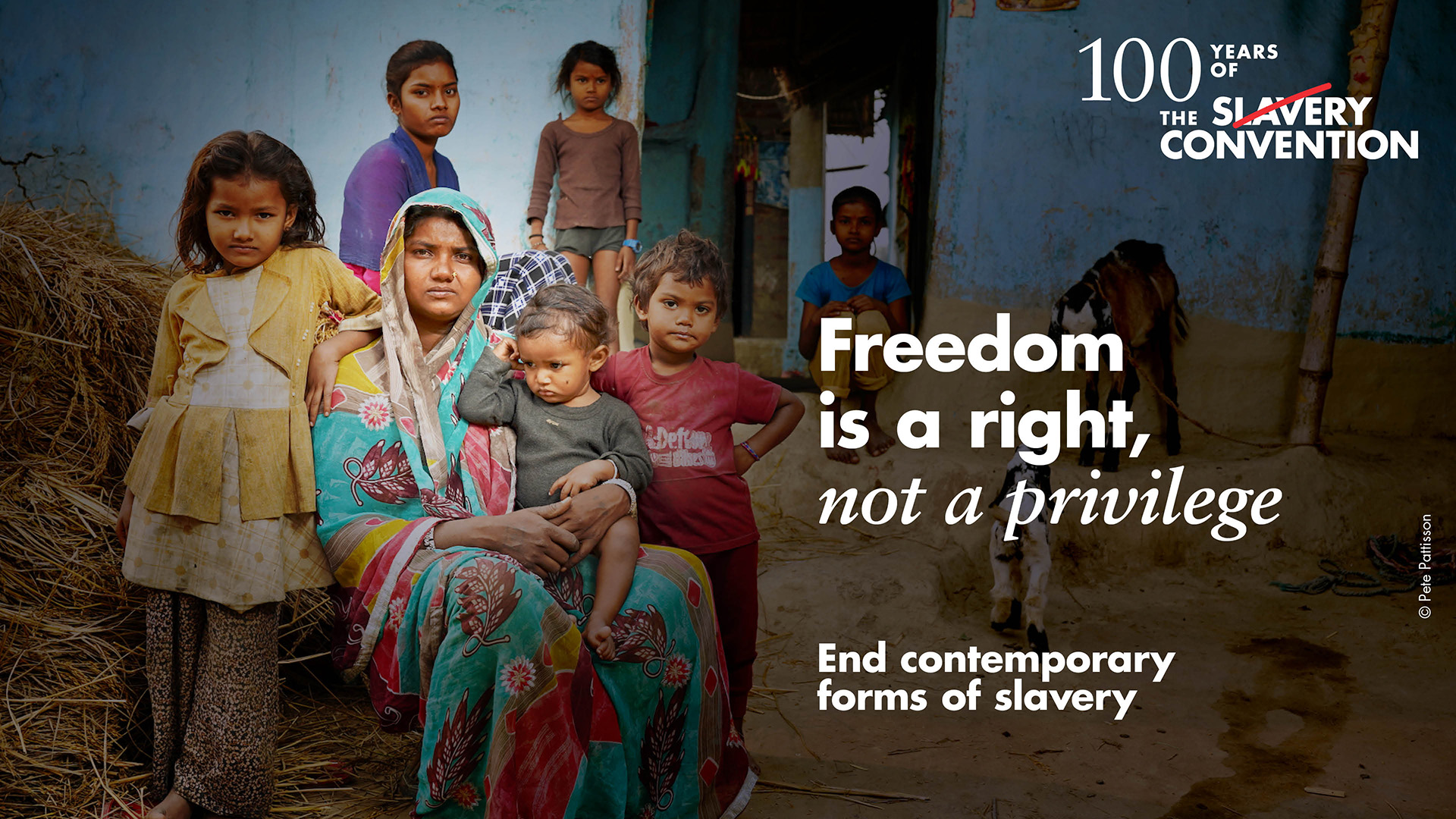
Freedom is a right, not a privilege

End contemporary forms of slavery

Why the centenary matters

Adopted in Geneva on 25 September 1926 and now ratified by 99 States, the Slavery Convention was the first international treaty to recognize that freedom from slavery is a fundamental human right. It laid the foundations of modern human rights law and galvanised global action against exploitation.

Despite its prohibition, slavery is not merely a practice of the past; it persists globally in contemporary forms.

Slavery today - hidden in plain sight

Around 50 million people globally continue to be subjected to contemporary forms of slavery.

Freedom is a right, not a privilege

Binita Das’s husband, Sitaram, died in Saudi Arabia when he was crushed by falling debris while working in a deep trench. He left the Siraha District in Nepal to try to earn enough money for a wedding dowry for each of his five daughters. Like most migrant workers from Nepal, Sitaram was subject to an abusive system which leaves many labourers in the Gulf in conditions of debt bondage and forced labour. Binita Das and family, in Siraha District, Nepal, December 2024. © Pete Pattisson

Where does slavery exist today?

Contemporary forms of slavery exist in every country and across many sectors of the global economy.

Contemporary forms of slavery are often invisible, behind closed doors, in factories, in homes or on remote agricultural plantations.

What are current forms of slavery?

Forced labour, debt bondage, descent-based slavery, serfdom, children working in slavery or slavery-like conditions, domestic servitude, sexual slavery, and servile forms of marriage.

Digital platforms are increasingly used to facilitate both sexual and labour exploitation, enabling traffickers to recruit, advertise, and control victims across borders with greater anonymity and reach.

Why does slavery still exist?

Contemporary forms of slavery persist due to underlying factors, including poverty and socio-economic and gender inequality; weak enforcement of relevant legislation, impunity, corruption and legacies of slavery and of the transatlantic slave trade; conflict and displacement; lack of regular migration pathways which increases vulnerability; harmful social norms and intersecting forms of discrimination; insufficient access to education and global demand for cheap labour.

Campaign overview

This yearlong global campaign runs from 2 December 2025 to 2 December 2026, International Day for the Abolition of Slavery to mobilize concrete action against contemporary forms of slavery. 

Campaign materials and implementation tools are available on the Trello Board. The campaign will also feature the work of photojournalist Pete Pattisson, highlighting contemporary forms of slavery in various regions and the resilience of survivors. 

Highlights

“Forms of slavery keep changing, but the harm remains the same.”

Ecaterina Schilling is the current Chair of the Board of Trustees of the UN Voluntary Trust Fund on Contemporary Forms of Slavery. At the occasion of the yearlong commemoration of the centenary of the Slavery Convention, Ms. Schilling underscores the pervasive nature of slavery, which, she says, remains a global problem that requires sustained, multi-stakeholder action to address its complex and evolving nature.

Read more