 Welcome to the United Nations

 OHCHR


Mental health and human rights
OHCHR and the right to health
Mental health is a fundamental human rights concern and essential to realize the right to health. More than one in ten people globally are current or potential users of mental health services at any given time. Yet access to appropriate, rights-based mental health care remains alarmingly limited – particularly in low- and middle-income countries. More than 75 per cent of persons with mental, neurological and substance use disorders in low- and middle-income countries receive no treatment at all, and in many countries, only two per cent of government health expenditure is dedicated to mental health.
Mental health and well-being are strongly associated with social, economic, and physical environments, as well as poverty, violence, and discrimination. However, most mental health systems follow a medicalized approach that focuses on diagnosis, medication, and symptom reduction, neglecting the social determinants that affect people’s mental health.
Discrimination and stigmatization of persons with psychosocial disabilities and users of mental health services remain alarmingly pervasive around the globe. Those challenges manifest in multiple forms. Some are denied care, others are exposed to inadequate and poor-quality services or inhuman living conditions, without safe water and basic sanitation. Involuntary hospitalization and treatment, seclusion or solitary confinement, and the use of restraints are also prevalent in many mental health systems.
Historically, users of mental health services and persons with psychosocial disabilities have been subjected to practices of segregation, institutionalization and isolation in mental health and social care. Existing legislation often fails to address the social and economic factors that affect mental health, and can thereby perpetuate discrimination and human rights violations, such as denial of legal capacity, coercive practices, involuntary institutionalization, and inadequate mental health care.
Human rights provide an actionable framework to transform and shift the paradigm on mental health from a narrow, biomedical approach, which has contributed to coercive environments in mental health services, to a holistic and inclusive understanding of mental health – therefore to a biopsychosocial model of mental health, ranging from community-based services to dedicated mental health care.
A human rights-based approach to mental health, as well as biopsychosocial support, calls for the development of person-centred care and support and a transition towards community based services, that are gender- and age-responsive and that take into account cultural acceptability and other considerations that safeguard human rights. It requires raising awareness and challenging stigma, eradicating discrimination and coercion, promoting community inclusion and participation; and developing accountability measures.
OHCHR’s work on Mental Health
UN Human Rights supports countries in the transformation of mental health services through capacity building, technical cooperation and advisory services to align laws, policies and practices with international human rights obligations and to enable the shift towards human rights-based mental health systems. This includes operationalizing the Mental Health, Human Rights, and Legislation: Guidance and Practice.
We protect and promote the rights of current or potential users of mental health services. We work with women, persons with disabilities, children, younger and older persons, migrant workers and their families, and their representative organizations. We pay particular attention to those who face multiple and intersecting forms of discrimination.
UN Human Rights works with UN human rights mechanisms and other UN entities to address to ensure compliance of mental health services with human rights obligations.
Reports and resources
- Mental Health, Human Rights and Legislation: Guidance and Practice – OHCHR & WHO (2023)
This joint publication by OHCHR and WHO offers practical guidance for aligning laws, policies, and practices with international human rights standards and for shifting away from coercive, biomedical models toward rights-based, person-centered mental health systems. See Publication Page
- Mental Health and Human Rights – Report of the United Nations High Commissioner for Human Rights A/HRC/58/38 (2025)
This report, submitted pursuant to Human Rights Council Resolution 52/12, presents key findings and recommendations for the realization of the human rights of persons with psychosocial disabilities and users of mental health services. See report page
- Summary of the outcome of the consultation on ways to harmonize laws, policies and practices relating to mental health with the norms of the CRPD A/HRC/49/29 (2022)
Submitted pursuant to HRC Resolution 43/13, this report summarizes the consultation held on 15 November 2021, which focused on aligning national mental health laws, policies, and practices with the Convention on the Rights of Persons with Disabilities (CRPD).
- Mental Health and Human Rights – Report of the United Nations High Commissioner for Human Rights A/HRC/39/36 (2018)
Submitted pursuant to HRC Resolution 36/13, this report summarizes the consultation held on 14-15 May 2018 on mental health as a human rights issue. Participants discussed the need for system-wide strategies and rights-based services to address discrimination, stigma, coercion, and abuse.
- Mental Health and Human Rights – Report of the United Nations High Commissioner for Human Rights A/HRC/34/32 (2017)
Submitted pursuant to HRC Resolution 32/18, this report identifies major challenges faced by persons with psychosocial disabilities and users or potential users of mental health services. See Report Page
Events and Consultations
Mental Health: From Rights to Reality, 23 March 2026
The event aims to examine contemporary human rights challenges relating to mental health across settings and in diverse institutional and operational contexts, with particular attention to bridging standards and practice. See Concept note, Event Flyer and Panellists Interventions.
Event on Suicide Prevention: 20 May 2025
This event on the margins of the 78th session of the World Health Assembly convened high-level decision-makers, civil society representatives, and global health actors, to strengthen visibility of suicide prevention as both a health and human rights emergency. See Concept Note and Event Flyer
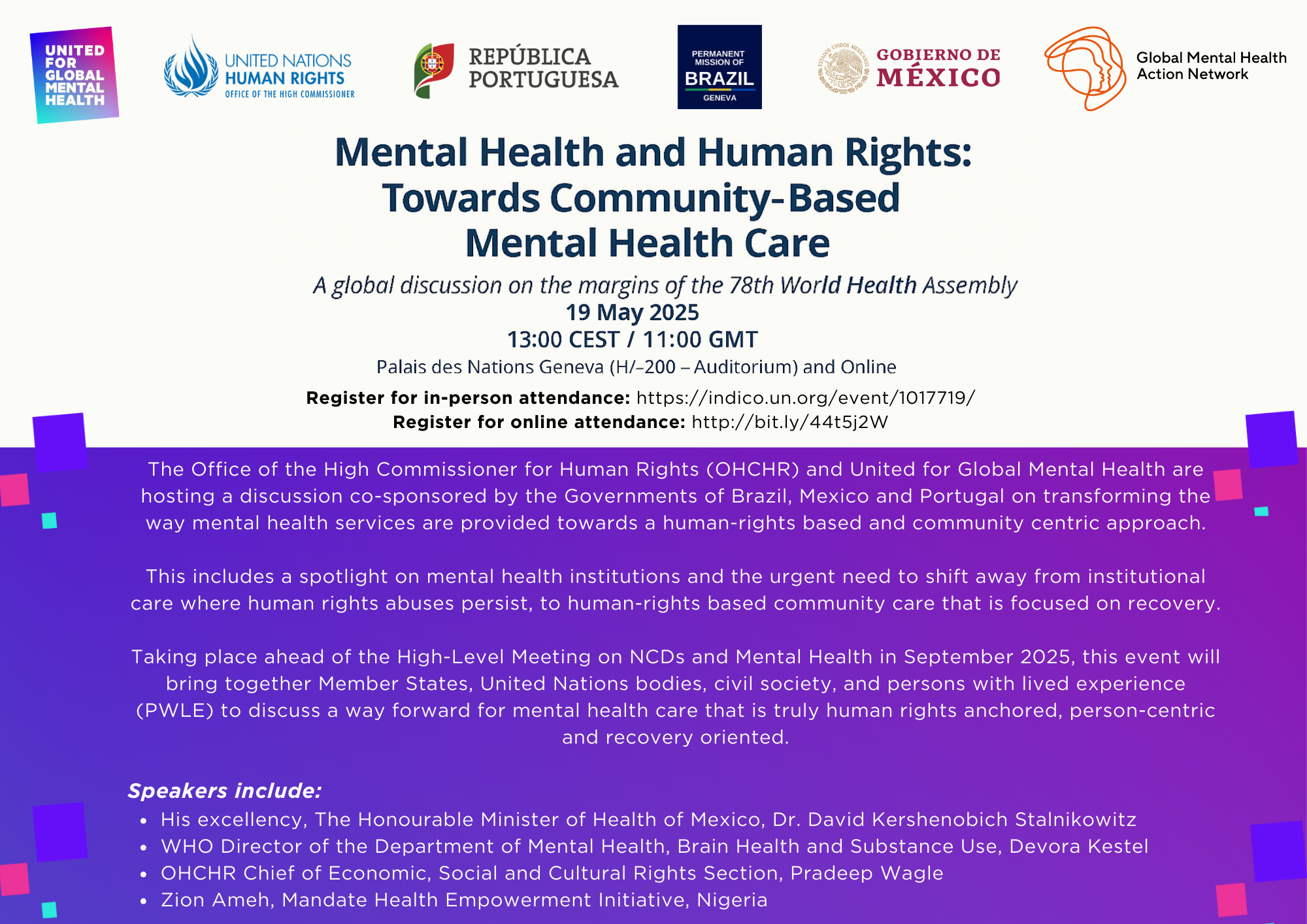
Event on Mental Health and Human Rights: Towards Community-based Mental Healthcare”, 19 May 2025
The event aimed to share good practices and lessons learned on transitioning to community-based mental health care at the national level. It aimed to showcase the importance of applying a human rights perspective to mental health and gathering support to make this a global priority at the World Health Assembly and UN High Level Meeting on Non-Communicable Diseases and Mental Health. See Concept note, Video recording and Event Flyer
Consultation on Mental Health and Human Rights, 23 October 2024
Pursuant to HRC Resolution 52/12, OHCHR convened a consultation on 23 October 2024 to examine key challenges and opportunities for advancing a human rights-based approach to mental health. The consultation informed the High Commissioner’s subsequent report to the Human Rights Council (A/HRC/58/38). See Event Page
Inter-sessional Consultation on Harmonizing National Laws, Policies, and Practices Relating to Mental Health with the CRPD, 15 November 2021
Pursuant to HRC Resolution 43/13, OHCHR convened a virtual consultation on 15 November 2021 to explore ways to align national mental health laws, policies, and practices with the Convention on the Rights of Persons with Disabilities (CRPD). It informed the High Commissioner’s report to the Human Rights Council at its 49th session (A/HRC/49/48). See Event Page
Consultation on Identifying Strategies to Promote Human Rights in Mental Health 14-15 May 2018
Pursuant to HRC Resolution 36/13, OHCHR convened a consultation on 14-15 May 2018 to identify strategies to promote human rights in mental health. The outcomes of the consultation informed the High Commissioner’s report to the Human Rights Council at its 39th session (A/HRC/39/36). See Event Page
Other resources
Resolutions on Mental Health and Human Rights
- General Assembly resolution 80/117 on noncommunicable diseases (NCDs) and mental health
- Human Rights Council resolution 52/12 (2023)
- Human Rights Council resolution 43/13 (2020)
- Human Rights Council Resolution 36/13 (2017)
- Human Rights Council Resolution 32/18 (2016)
Reports of Special Rapporteurs
- Report of the Special Rapporteur on extreme poverty and human rights. The burnout economy: poverty and mental health (2024), (A/79/162).
- Report of the Special Rapporteur on the right of everyone to the enjoyment of the highest attainable standard of physical and mental health on the global agenda for mental health that is human rights-based (2020), (A/HRC/44/48).
- Report of the Special Rapporteur on torture and other cruel, inhuman or degrading treatment or punishment (2020), (A/HRC/43/49).
- Report of the Special Rapporteur on the right of everyone to the enjoyment of the highest attainable standard of physical and mental health on the role of the determinants of health in advancing the right to mental health (2019), (A/HRC/41/34).
- Report of the Special Rapporteur on the rights of persons with disabilities (2018), (A/73/161).
- Report of the Special Rapporteur on the right of everyone to the enjoyment of the highest attainable standard of physical and mental health on mental health (2017), (A/HRC/35/21).
Key Publications
- WHO Guidance on community mental health services: Promoting person-centered and rights-based approaches (2021)
- WHO QualityRights e-training on mental health
- QualityRights materials for training, guidance and transformation
- UNECE – Mental Health and Older Persons (UNECE Policy Brief on Ageing No. 29)
Useful Links