 Welcome to the United Nations

 OHCHR




Human rights don’t protect themselves.
Your donation protects the essentials we all rely on.
12 June 2026

The UN Human Rights team, and European Union representatives, engaged with an Indigenous community in Chiang Mai, northern Thailand, in September 2025. © OHCHR
The world is facing a paradox. While wealth and technological advancement continue to expand, so do inequality, discrimination, and conflict. Public discourse is increasingly shaped by polarization, hate speech, racism, and misogyny.
At the same time, long-term global challenges — from the climate crisis to the unchecked development of powerful technologies — compete for attention in an increasingly fragmented world.
Against this backdrop, UN Human Rights spent 2025 working tirelessly to ensure that human rights remain both a guiding principle and a practical tool for change.
The newly released Annual Report 2025 highlights examples of that effort and the lives transformed through human rights action globally.
“It sets out the many concrete ways in which we provide a lifeline for the abused, amplify the voices of the silenced, and stand with those who risk everything to defend the rights of others,” said UN Human Rights Chief Volker Türk.
Türk also added that UN Human Rights stepped up reform efforts to be closer to the people that the Office serves and better respond to their needs.
These achievements were delivered amid a wider UN financial crisis. Despite these constraints, ongoing reforms helped ensure continued progress and enabled the results highlighted in this report.
For millions of people facing violence, discrimination, detention, and exclusion, human rights are not abstract ideals. They are often the difference between fear and protection, silence and justice, vulnerability and dignity.
Throughout 2025, UN Human Rights carried out more than 5,000 monitoring missions and observed over 1,300 trials worldwide.
The Office documented tens of thousands of violations, exposed discrimination in more than 100 countries, and helped secure the release of over 4,900 people from arbitrary detention.
The Office also supported approximately 67,000 survivors of torture and contemporary forms of slavery, providing assistance and helping ensure that their suffering was not ignored.
The report shows the critical role human rights play in conflict and humanitarian crises.
From the Democratic Republic of the Congo to the occupied Palestinian territory, Myanmar, Sudan, and Ukraine, UN Human Rights teams documented civilian casualties, investigated violations, informed humanitarian responses, and gathered evidence that could contribute to future accountability efforts.

UN Human Rights Chief Volker Türk and Li Fung, OHCHR Representative in Sudan, discussed issues faced by internally displaced persons in Northern State, Sudan, after fleeing violence in Darfur and Kordofan. © OHCHR/Anthony Headley, January 2026.
In Gaza, nearly 1.7 million people received protection services through UN Human Rights’ leadership role in emergency protection initiatives.
In Haiti, more than 6,500 survivors of violence gained access to emergency medical care, psychosocial support, safe shelter, and survivor-centered services.
In the Democratic Republic of the Congo, support for justice mechanisms helped over 1,000 victims and survivors pursue accountability.
These efforts demonstrate how human rights work extends far beyond reporting abuses. It includes providing protection, supporting recovery and helping communities rebuild after crisis.
Human rights work is not limited to responding to crises. It also focuses on addressing the systemic factors that drive inequality and exclusion.
During 2025, UN Human Rights collaborated with more than 35 governments through its Human Rights Economy initiative. The goal was to ensure that economic policies benefit everyone, not only a privileged few.
The Office also provided human rights analysis to United Nations Country Teams working to advance sustainable development, helping integrate principles of equality, participation and accountability into national development efforts.
On 27 November, Zimbabwe launched its National Development Strategy 2 (2026–2030). The UN, including the Office, supported the Government in integrating the Sustainable Development Goals (SDGs) and human rights into the Strategy.
As a result, the framework commits to advancing international human rights obligations and promoting inclusive policies on gender equality, youth empowerment, disability inclusion and social protection, while ensuring more equitable access to health care, education, housing and economic opportunities.
At a time when economic disparities continue to widen globally, these initiatives seek to place human dignity at the center of policymaking.
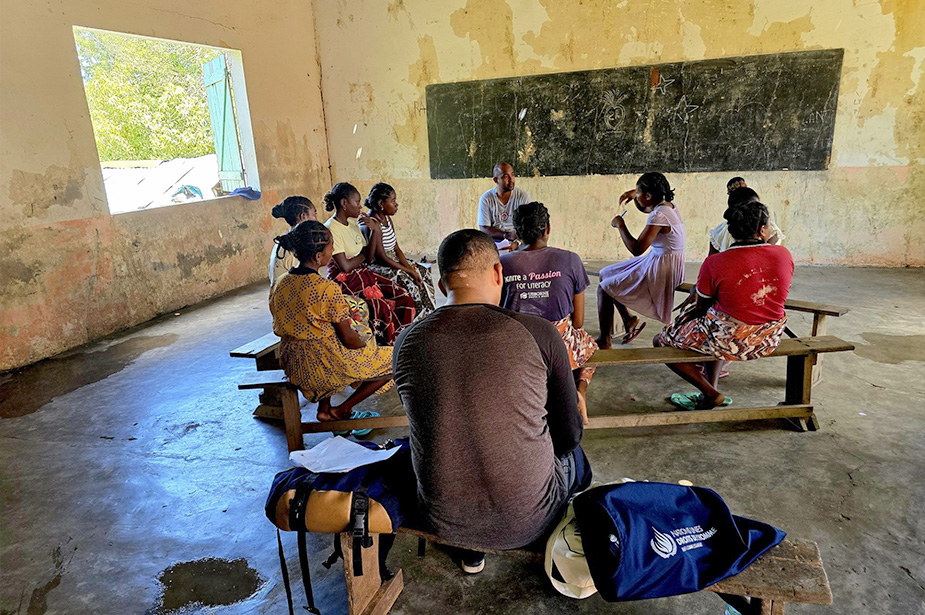
A UN Human Rights data collection mission in Madagascar’s Menabe region, carried out under a Peacebuilding Fund project, combined legal and socio-anthropological analysis to deepen understanding of traditional justice practices and strengthen access to justice for affected communities. © OHCHR
One of the report’s strongest messages is that accountability matters. By documenting violations and supporting victims, UN Human Rights helps ensure that abuses don’t remain hidden and that governments and institutions are encouraged to meet their obligations.
The UN Human Rights Monitoring Mission in Ukraine (HRMMU) made a significant contribution to accountability efforts through its monitoring, documentation, analysis, and reporting of human rights violations. The credibility and quality of its work are reflected in the reliance placed on its findings by international judicial bodies, including the European Court of Human Rights (ECtHR).
Despite these achievements, the report delivers a stark warning. The demand for human rights work is growing, but resources are shrinking. Severe funding cuts have pushed the organization into what Türk describes as “survival mode.”
Reduced funding means fewer monitoring missions, less documentation of abuses, diminished accountability efforts and fewer opportunities to prevent violations before they escalate.
The consequences extend beyond individual cases. Over time, weakened human rights protections can erode trust between people and institutions, undermine social cohesion, and threaten peace and stability.
In 2025, partners contributed approximately US$262 million to support UN Human Rights’ operations. Yet projections for 2026 indicate a funding shortfall of around US$50 million compared to last year.
To continue defending civil, political, economic, social, cultural, and environmental rights worldwide, UN Human Rights estimates it will require US$400 million in voluntary contributions.
While the challenges are significant, the Annual Report is ultimately a story of people. It is a story of survivors demanding justice, communities defending their rights, activists refusing to be silenced and human rights defenders standing alongside those most at risk.
Every day, the countless acts of kindness and courage, of solidarity and support, that abound across movements for peace, rights, and dignity are quietly changing lives for the better.
Volker Türk, UN Human Rights Chief
“They are a powerful counterbalance to the division and cruelty that make the news, and they prevent us from becoming numb to the absurd contradictions and cynicism of today’s world,” Türk said.
Watch this video on the 2025 Annual Report:
Your donation protects the essentials we all rely on.