 Welcome to the United Nations

 OHCHR


Statements and speeches Multiple Mechanisms
HC Türk to Forum on Business and Human Rights: “The world looks to business to play its part”
25 November 2024
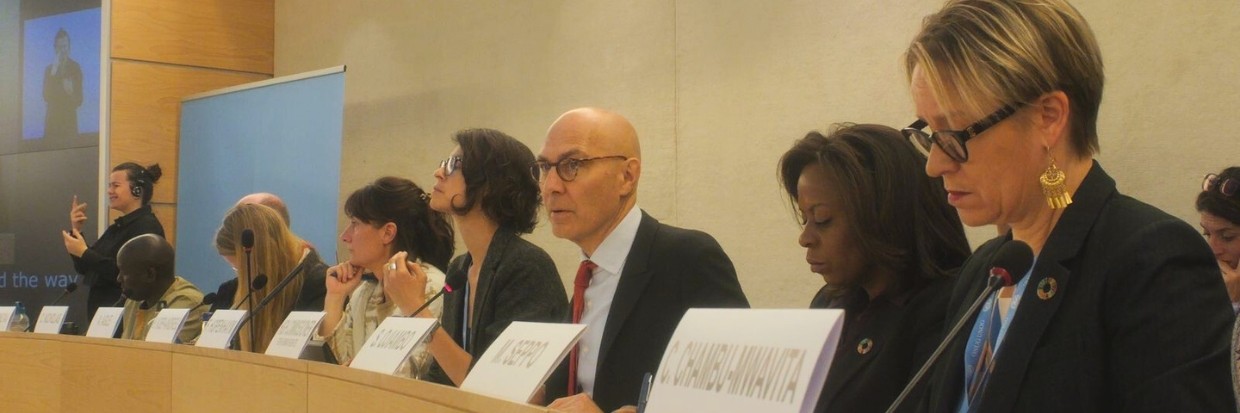
Delivered by
Volker Türk, UN High Commissioner for Human Rights
At
13th United Nations Forum on Business and Human Rights
Location
Geneva
Realizing the “Smart Mix of Measures” to protect human rights in the context of business activities
Excellencies,
Distinguished Chair and Members of the Working Group on Business and Human Rights,
Distinguished panellists,
Colleagues and friends,
I am pleased to join you at this year’s Forum on Business and Human Rights. This unique and dynamic gathering for Governments, business, civil society, is a key opportunity for constructive discussions and debates on human rights and business – and the way forward.
This is a particularly difficult, complex and dangerous time.
Conflicts are escalating and multiplying, climate chaos is already a reality in many parts of the world, inequalities are deepening, and new technologies are being developed without the necessary guardrails.
Leadership to guide us out of these multiple, intersecting crises is in short supply.
We urgently need that leadership, from governments, from civil society and from business, to find solutions that are sustainable, equitable and just.
For the interests of all, not just for the privileged few.
We need leaders who value long-term stability over short-term wins. This is one of the big issues of governance today.
And we need leaders who recognize that anchoring our economies and business ventures in human rights can make our societies more stable, more predictable, more peaceful – and ultimately, more prosperous.
I welcome the efforts of many of you gathered here - representatives of Governments, business, civil society, associations, who work tirelessly towards achieving the change that is needed. Your commitment and sustained action are vital to moving the needle on this issue and to propel in particular the private sector towards greater responsibility, solidarity and sustainability.
It remains troubling that business-related human rights abuses continue and are significant in some parts of the world. From the poisonous impacts of the fossil fuel industry to the exploitation by companies of rare and precious raw materials in conflict. From unlawful AI-powered surveillance technologies, to AI-powered discrimination at-scale. From forced displacement of Indigenous Peoples to exploitative working conditions in agriculture and other industries.
These practices are all leading to deeper inequalities and deeper injustice.
We need decisive action to change course.
The UN Guiding Principles on Business and Human Rights are a key tool for States and business to ensure that business-related human rights abuses are prevented, mitigated, and addressed.
The last decade has seen important progress, with States and businesses adopting some relevant measures.
These include regional initiatives like the adoption of the European Union’s Corporate Sustainable Due Diligence Directive, and a growing number of National Action Plans on Business and Human Rights, for example in Argentina, Liberia, and Nepal just this year.
But voluntary approaches alone are not enough.
Rather, there is increasing evidence that a smart mix of coherent policy and regulatory measures – of national and international, mandatory, and voluntary measures is an effective way for States to provide clarity for business, level the playing field, and ultimately ensure better results for people harmed by business operations.
Protection and support measures for affected individuals and communities, as well as accountability and remedy mechanisms are crucial parts of a rich, smart mix, and my Office can support States in formulating them.
It is also vital to protect human rights defenders working on all issues, from the environment to digital rights, and who shine a light on business-related human rights violations and abuses. I am particularly concerned by the growing phenomenon of transnational repression of human rights defenders that has evolved with digital technologies. The old, crude forms – abductions and anonymous threats from a distance – are now compounded by digital attacks, online surveillance, and the tracking of people across borders. We must ensure that human rights defenders who expose corruption or dangerous practices are safe, wherever and whenever they stand up for human rights.
Implementing the UN Guiding Principles and other international standards agreed by the International Labour Organization, the Organization for Economic Cooperation and Development, and the UN Global Compact must remain a priority.
More broadly, I urge us all to expand the way we measure economic success beyond GDP so that we have a holistic picture of how economies are delivering on people's rights. Importantly, this was recognized in the Pact for the Future.
The need for a human rights economy, a key advocacy priority of my Office, has never been more urgent. Where economic and social decision-making are guided by and invest in human rights - from education to social protection, to housing, to climate and tax policy.
Such economies can withstand the biggest and deepest of shocks – and that is in everybody’s interest.
Because we cannot continue operating with short-term logic.
A hard look reveals that the current modus operandi is steering us to failure.
Our capacity to harm - and frankly to extinguish - all of humanity has taken on unparalleled dimensions – from the climate disaster to unregulated technological developments. And the decisions we make today will determine the course of humanity for generations to come.
Yet, we can choose to harness the fast-evolving technological capacity and other tremendous resources at our disposal to contribute to the well-being of future generations.
We must do everything we can to ensure that every decision taken today factors in its impact on human rights and our planet generations down the line. Not just for one electoral cycle, and not just for the length of a Chief Executive Officer’s term. We all have to be good, responsible ancestors, leaving a legacy behind that is honourable.
This must be a unified effort, by us all – States, business and business associations, business schools, civil society, international organisations, and affected people and communities, including trade unions, human rights defenders, and Indigenous Peoples – so that we are able to realise the full potential of human rights.
Distinguished participants,
Business, like every part of society, benefits from peace. From justice. From sound, stable institutions. From free societies and economies that are developed sustainably. And from a business reputation that is clean of any engagement in human rights harm.
At this perilous time, the world looks to business to play its part, more importantly than ever.
I urge the business leaders among you who recognise the immense value of human rights in your business practices to use your influence and your voices, and to help put our world back on the right path.
That is leadership we can look up to.
I wish you constructive and fruitful discussions in the coming days.