 Welcome to the United Nations

 OHCHR




Human rights don’t protect themselves.
Your donation protects the essentials we all rely on.
02 May 2025

“The trust of the people who want the truth to be known, who want to give their testimony and want things to change in my region… They are the ones who have given me strength to do this job,” said Manuel Calloquispe Flores.
Calloquispe Flores has worked as a journalist for the past 15 years and for more than 10 years has investigated illegal gold mining in La Pampa, in the southeastern Amazonian region of Madre de Dios, Peru.
La Pampa is located in the buffer zone of the National Reserve, a region Calloquispe Flores describes as a lush jungle rich in biodiversity and wildlife, the place where he was born and grew up taking long walks, running through the forest and bathing in its streams. Today, criminal gangs have overrun the region, illegally mining, moving and trading gold in an otherwise well regulated industry.
Mining is not allowed in the area because of its adverse impact on conservation. Since 2011, between five and 15 hectares of land are deforested daily, he said, and more than 600 tonnes of mercury have been dumped in the soil to extract gold.

Manuel Calloquispe Flores photographed on the Peruvian Air Forces base in Puerto Maldonado, Peru, July 2014. © Manuel Calloquispe Flores
Calloquispe Flores regularly reports on the environmental damage and organized crime in La Pampa. He was the first journalist to publicly expose cases of disappearances related to illegal mining in Madre de Dios. He never planned on becoming a journalist, as he studied business administration. However, when he returned home from the capital Lima where he went to university, he saw the magnitude that mining had taken. Enticed by the rise in the price of gold, people and criminal groups started migrating to La Pampa. “An invasion,” he said.
“The panorama was changing and nobody cared about the impact of mining, so I started to write for a local newspaper,” Calloquispe Flores recalled. “Then I hosted a programme on local television and I dedicated myself to denouncing what was happening.”
Calloquispe Flores began keeping records of people disappearing in the mines. “Nobody would report on this,” he added. “So I dedicated myself to defending the lives of the disappeared, of the families who were searching for their loved-ones, the mothers and their children who were looking for their fathers. I had to.”
As a result of his investigative work, Calloquispe Flores has suffered various incidents throughout his career. In April 2013, he was assaulted inside his home and in front of his children while covering protests related to illegal mining in Madre de Dios. Two years later, he was once again assaulted on the Madre de Dios River by illegal miners who stole his recording equipment.
One of the most serious threats he faced took place in January 2023, when he was physically assaulted by a group of protesters while livestreaming for Latina TV in Puerto Maldonado, the capital of the region. Calloquispe Flores also received death threats via WhatsApp and Messenger and experienced harassment near his home. As a result, he was forced to flee the area.
“Where I work is not a place where criminal gangs or those I denounce will send a letter asking for a correction, file a complaint for defamation or slander, or attack me on social media. These people will hire a hitman and pay them to kill me,” he said.

Smoke and ashes seen in the Peruvian Amazon as thousands of plants and trees are burned for land dedicated to cultivation, livestock or illegal mining, Madre de Dios, Peru, 04 September 2022. © EPA-EFE/Paolo Aguilar.
Calloquispe Flores said that a few people working in the mines have come forward to provide him with information on the illegal activity in the mines to report on. Many fear reprisals from gangs and have lost their trust in law enforcement and the judicial system. Calloquispe Flores said that, in January 2025, a woman working in La Pampa handed him over sensitive information, asking him to report on it directly.
“I had to agree. I was a journalist, an ordinary citizen in my locality who was given sensitive information that could affect a person’s life and I couldn’t give it to the authorities. I had to put a story together,” he said.
Calloquispe Flores felt he had a sacred duty to fulfill and a debt owed to his source who had put her own life in danger to affect change. His story was about the discovery of four bodies in La Pampa and was picked up by one of the biggest media outlets in Peru. “That became my best work and at that stage, I could see very clearly, unlike in previous years, that I would get good things out of this. I felt much more confident.”
The same month, he was alerted of threats made against him by allegedly illicit actors. He also reported receiving intimidating calls from unknown numbers and, according to the victims’ families, he was being monitored by various criminal organizations in La Pampa.
From then, Calloquispe Flores also realised that he had reached an unprecedented level in his career and notoriety. He needed to put a system in place to store and protect the sensitive information he received, away from his home.
UN Human Rights Peru has been monitoring and following up on Calloquispe Flores’ case since 2022, coordinating with the Intersectoral Mechanism for the Protection of Human Rights Defenders of the Ministry of Justice and Human Rights, to ensure the provision of protection guarantees and supporting him on three occasions through international self-protection grants.
Since 2022, the Office has documented (PDF) 194 incidents of attacks against journalists, involving 251 victims. It developed an internal case documentation and verification system, as well as a database and a dashboard on attacks against journalists, which provides early warning information and analysis to stakeholders.
UN Human Rights Peru identified factors that directly threaten the work of journalists and communicators including stigmatization, harassment and threats, criminalization, and physical assaults. Recent legislative proposals have posed additional challenges to freedoms of expression, association, and defence of human rights.
The Office also provides technical assistance to the Ministry of Justice and Human Rights and its Intersectoral Protection Mechanism for Human Rights Defenders to follow up on cases of journalists at risk and implement prevention and protection measures.
In 2024, the Office prepared a baseline study on the risk to journalists and social communicators, to provide contextual and early warning information and analysis of their situation, with analysis and recommendations to share with relevant institutional actors. It has also supported the development of a self-protection toolkit for human rights defenders and journalists, with a dedicated chapter on self-protection measures during protest covering. The Office regularly participates in the regional roundtables of the Intersectoral Mechanism as part of its ongoing technical support to the national protection mechanism.
OHCHR Peru has also provided technical assistance to the Public Prosecutor’s human rights office to review and update its internal protocol on the investigation and prosecution of crimes against human rights defenders and journalists.
If I don’t tell the story, nobody will tell it.
Peruvian journalist Manuel Calloquispe Flores
Like many journalists around the world, despite all the threats and risks to themselves and their families, Calloquispe Flores continues investigating illegal activities in Madre de Dios, hoping to expose the grave human rights violations committed by organized crime in the region.
His two sons are now in college. Since receiving threats and attacks against him and his family, Calloquispe Flores had to move them for their safety.
“I can’t see them,” he said. “One day, my son told me "Dad, you go out and we don’t know when you’re coming back. I’m scared.’ But, I couldn’t leave my job. If I don’t do it, who is going to? At least, my family is in a safe place.”
“A lot of lives were lost, a lot of people were disappeared. People migrated from the Andes, healthy and decent. But, when they arrived in La Pampa to work, they became criminals,” Calloquispe Flores said.
“People came looking for something for their children and they lost their lives. Girls came to finish their university degrees and they found death. This needs to stop.”
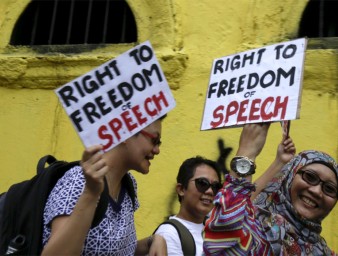
Each year on 3 May, the world celebrates World Press Freedom Day to support a free and independent media, “the lifeblood of a resilient society,” UN Human Rights Chief, Volker Türk, said in his video statement for the Day.
This story is part of an occasional series of stories of individuals or organizations that stand up for human rights. The views expressed in these stories do not necessarily reflect the position and opinions of UN Human Rights.
Your donation protects the essentials we all rely on.