 Welcome to the United Nations

 OHCHR


Human rights don’t protect themselves.
Your donation protects the essentials we all rely on.
03 July 2025

“Corruption is not a victimless crime. When hospitals and schools aren’t built because public officials divert funds from public contracts, the right to health and the right to education are violated,” said Pradeep Wagle, Chief of the Economic, Social and Cultural Rights Section. When local authorities demand bribes for the provision of free services, it is the marginalized, vulnerable and the economically disadvantaged who suffer most, and who have their right to non-discrimination violated,”
Corruption takes different forms across countries and sectors and, because of its hidden and illicit nature, measuring how much is lost corruption is technically complex. While an estimated USD2.6 trillion are stolen through corruption — a sum equivalent to more than 5 percent of the global GDP — according to the United Nations Development Programme, another figure commonly used is over USD1 trillion paid in bribes every year.
Corruption exists in all countries but is also a transnational phenomenon requiring international cooperation, including in the recovery of the proceeds of corruption.
Not only does corruption deprive populations of essential services, it also undermines States’ ability to meet their legal obligations to maximize all available resources to respect, protect and fulfil economic, social and cultural rights. It also poses a challenge to the functioning and legitimacy of institutions and processes, the rule of law and the State itself.
UN Human Rights fights corruption by being human rights centred. It makes sure anti-corruption efforts respect countries' human rights responsibilities, put victims first, and investigate how corruption harms people’s economic, social, and cultural rights. The Office’s approach includes prevention, effective administration of justice and redress for the victims of human rights violations caused by corruption related offences and anti-corruption responses.
Corruption steals for personal gain from the common resources that should benefit all.
Volker Türk, UN Human Rights Chief
The Office has developed a multiyear strategy to address corruption from a human rights perspective. This includes organizing a series of trainings around the world that bring together civil society actors, representatives of regional intergovernmental bodies, and governments and other agencies working on corruption and human rights.
“We are advocating to countries that they promote effective institutions, adopt appropriate laws and policies, good governance, as well as justice and redress for victims,” Wagle said. “Civil society plays a key role in anti-corruption efforts, and their full and meaningful participation is essential across all areas of anti-corruption policy development, implementation and monitoring.”
This year, UN Human Rights hosted one of its trainings in Banjul, capital of The Gambia, with an aim to strengthen the capacity of national anti-corruption oversight and policy-making bodies and institutions to adopt a human rights-based approach to responding and preventing corruption.
Following the fall of former president Yahya Jammeh, during whose 22-year rule corruption plagued the country, in 2017 the National Human Rights Commission of The Gambia was established to promote and protect human rights in the country. Education and awareness raising is at the core of the Commission’s mandate.
“The gaps within the domestic setting in The Gambia is knowledge on the linkage between corruption and human rights. Obviously, people know what corruption is, but we want them to know that it is not a victimless crime and what the link is and how to ensure that funds are adequately allocated so the services the people need are provided,” said Mam Ndeban Jobe, Director of the Commission’s programmes and resource mobilization department. “Human rights-based budgeting is something that the Commission is working on to ensure the appropriate allocation of public finances for the needs of the people.”
Ndeban Jobe pointed out that the Commission has a strategic objective to eradicate poverty in The Gambia and addressing corruption contributes to that objective.
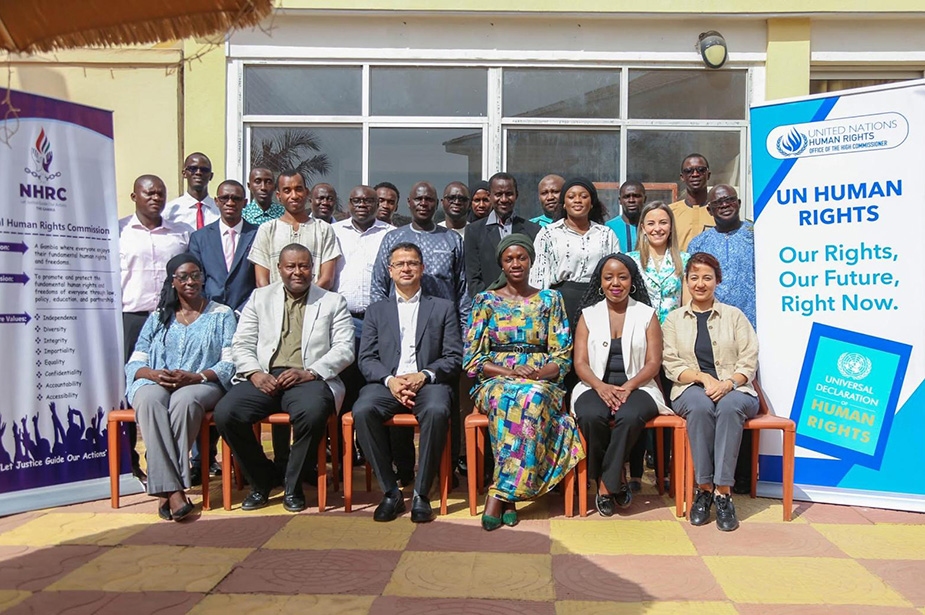
OHCHR trained the National Human Rights Commission of The Gambia on a human rights-based approach to addressing corruption, Banjul, 22 April 2025. ©Gambia NHRC
For Marr Nyang, founder of the civil society organisation Gambia Participates, corruption is what led his country to a 22-year dictatorship and kleptocracy under President Jammeh. Today, he calls for more accountability.
“The resources that are available and allocated for the citizens should be used in that direction, judiciously, in the areas of health, education, road infrastructure, you name it. If there is no external oversight, different from government oversight, these resources will land in the wrong hands, like we experienced previously,” he said. “I also want to ensure that we have financial probity and integrity in our public finance management but, most importantly, that democracy works. And if democracy works, it will be to the benefit of the citizens.”
Nyang pointed out that Gambia Participates was instrumental in linking corruption to human rights and bringing victims’ voices in the transitional justice process that took place in The Gambia following Jammeh’s downfall. This led government to accept the recommendation made by the Truth, Reconciliation and Reparations Committee to provide financial redress to victims.
Sarah Wesonga is the Regional Coordinator for Sub-Saharan Africa of the UNCAC Coalition, an alliance of over 480 civil society organizations working to advance anti-corruption efforts in their countries, and a Senior Programme Manager at Article 19 Eastern Africa, which promotes people’s rights to freedom of expression and access to information to hold leaders to account.
With both roles, Wesonga understood how information and a human rights-based approach were important in advancing anti-corruption initiatives in the region, breaking down silos between these initiatives for greater impact for the people and to allow civil society to devise outcomes that benefit society.
“A key change that I would like to see in this space is to create an opportunity for different and diverse voices to be included in both national, regional and international spaces,” she said. “We need to be able to see an opportunity for government, State actors and different stakeholders to work together to advance the lives of the people that they serve.”
For Wesonga, trainings and other support provided by UN Human Rights offer opportunities for collaboration and constructive feedback between civil society, State actors and other stakeholders to concretely improve the lives of people on the ground.
Through its regional trainings, UN Human Rights hopes to promote the use of UN human rights mechanisms through strategic policy guidance, discuss strategies and good practices against corruption, and strengthen cooperation between State institutions, civil society actors and other anti-corruption. These outcomes of these regional workshops will form the basis for an advocacy tool for civil society organizations on the use of the UN human rights system to address corruption.
The technical assistance training in The Gambia was supported by a grant from the German Federal Ministry for Economic Cooperation and Development though the Deutsche Gesellschaft für Internationale Zusammenarbeit GmbH.
Your donation protects the essentials we all rely on.