 Welcome to the United Nations

 OHCHR




Human rights don’t protect themselves.
Your donation protects the essentials we all rely on.
14 September 2026
“Participation does not mean simply being heard. It means knowing what happened with what we said,” said Karen, a seventeen-year-old activist from Mexico and child representative from the Latin American and Caribbean Group.
She was part of a cohort of children who participated in the second session of the Open-ended Intergovernmental Working Group on an optional protocol to the Convention on the Rights of the Child, held in Geneva.
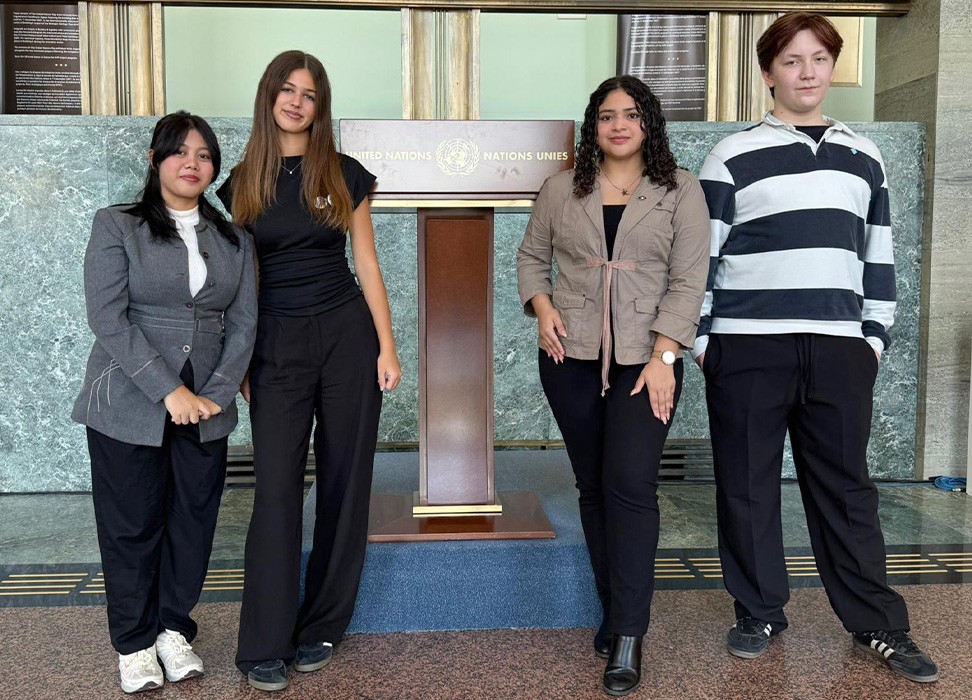
Like Karen, Lana, Roberto, Sania and Trond are child representatives from Croatia, Liberia, Indonesia and Sweden respectively, who are advocating for expanding children’s right to education and highlighting the realities that prevent many children from accessing it.
Free education for children was recognized as a fundamental right under the 1948 Universal Declaration of Human Rights. Since then, it has been advanced in international law by the 1966 International Covenant on Economic, Social and Cultural Rights and the 1989 Convention on the Rights of the Child (CRC), which legally guarantee free primary education and call for the progressive introduction of free secondary education. No international human rights treaty guarantees children’s rights to early childhood education and care, and to free pre-primary education.
Yet, there is a need for greater access. UNESCO’s Global Education Monitoring Report estimates that 273 million children globally were out of school in 2024, the majority of them of secondary school age. Meanwhile, only about 60 per cent of primary school students globally have received at least one year of pre-primary education, with participation considerably higher in countries where pre-primary education is free or compulsory.
The five child representatives came to Geneva to take part in the second session of the Human Rights Council’s open-ended intergovernmental working group, which is considering a possible new optional protocol to the Convention on the Rights of the Child on the rights to early childhood education, free public pre-primary education and free public secondary education.
This was made possible through the Human Rights Council's adoption of resolution 56/5 in July 2024, which established an Intergovernmental Working Group to develop a possible new optional protocol to the Human Rights Council, while ensuring children’s meaningful participation in informing its work.
Between December 2025 and July 2026, the five child representatives co-organized and co-led consultations across five regions to identify barriers to education and contribute to the development of the possible Protocol. During the session, they presented their own perspectives, as well as findings and video messages from children who took part in regional consultations.

Child representative participation in the second session of the Open-ended Intergovernmental Working Group on an optional protocol to the Convention on the Rights of the Child, held in Geneva, Switzerland. ©OHCHR/Yasamin Kashfi
Twelve-year-old Trond is a board member of Save the Children Youth Sweden and the child representative from the Western European and Other States Group. He said the hidden costs of education were raised as a major barrier to accessing free education across every regional consultation.
“The potential protocol isn’t just about naming what costs exist. It's about the fact that if we don't define what 'free' actually means, a government can say, on paper, that it has fulfilled its obligation under this Protocol — while a child is still sitting at home because their family couldn't afford the bus fare that morning," he said.
Across the regional consultations, children identified poverty as affecting both educational access and retention, as many families prioritize basic needs over pre-primary and secondary education. Indirect costs of education, teacher shortages and inadequate infrastructure in remote areas present additional barriers for children to exercise their right to education.
Seventeen-year-old Sania from Indonesia and a member of the Yayasan Semai Jiwa Amini (SEJIWA) Foundation participated as the child representative for the Asia-Pacific region. Her consultations revealed that a child’s access to quality education depends on where they live or how much their families earn.
"In big cities, schools have modern and complete facilities,” she said. “But in remote areas, poverty slows down progress, so many schools end up damaged and poorly maintained, making it difficult to learn in a safe and comfortable environment."
Her consultation focused on barriers to accessing pre-primary and secondary education, as she pointed out that pre-primary education is crucial for developing social skills, independence and connecting with other children. However, she said, families in poverty see pre-primary education as an additional expense, which limits children's opportunities to benefit from early learning.
Education is only truly free when it is truly accessible — and when no child is left behind.
Lana, Child rights activist from Croatia
Lana, a fifteen-year-old Croatian child rights advocate and the child representative from the Eastern European Group, is a member of the Opatija Children’s City Council. She discussed the challenges faced by vulnerable groups in accessing education, saying “Children do not all experience education in the same way.”
"Data should be disaggregated wherever possible — for example by disability, gender, poverty, migration or displacement, and location. General statistics can show that a country is making progress while hiding the fact that certain groups of children are not benefiting from that progress," she said.
A right denied to one child, anywhere, is a risk to all of us.
Roberto, Child rights advocate from Liberia
Seventeen-year-old Roberto from Liberia, the child representative from the African Group, expanded on Lana's statement by calling for international solidarity and cooperation for States that are in conflict or lack resources to fund free education. He stressed the importance of the possible Optional Protocol.
"It brings the question of solidarity to the center of the discussion: the responsibility of States to cooperate, to help finance free education where it's needed," he said.
The primary objective of the second session was to bring together Governments, experts, civil society representatives and child advocates to discuss key principles that could guide the drafting of a new possible Optional Protocol on early childhood education, free public pre-primary and free secondary education. It also marked an important step in ensuring that children are not simply consulted but have an active role in shaping the process. As the Working Group advances its deliberations, children ask to stay involved in the process.
The real challenge isn't opening the door once to listen to children. It's ensuring that the door remains open when the time comes to implement it.
Karen, Child activist from Mexico
The child representatives called for children's participation to extend beyond the drafting of the possible Optional Protocol to its implementation and monitoring.
“A report about children's education, written entirely without children, is missing the one perspective that actually knows whether it's true," Trond said.
They further stressed that participation should ensure the voices of children disproportionately affected by poverty, discrimination, displacement and gender inequality are heard, not as an addition to monitoring, but as essential evidence of whether their right to education is being realized.
Your donation protects the essentials we all rely on.