 Welcome to the United Nations

 OHCHR



Human rights don’t protect themselves.
Your donation protects the essentials we all rely on.
18 September 2026

Fishing, reindeer herding and traditional knowledge are more than livelihoods, in Inari, northern Finland. They are part of the Sámi cultural identity.
Heikki Nikula, a chef and fisherman, stands where his father stood, and his grandfather before that, guiding his boat against the river current.
Nikula described fishing as a tradition, “a tradition that is still very much alive today."
Inari, known as the cultural and political capital of the Sámi living in Finland, stretches across northern Norway, Sweden, Finland and the Kola Peninsula of Russia.
Climate change and aquaculture feed pressures, among other factors, are having an impact on fishing. Nikula remembers fish over twelve kilos being pulled from waters in his neighbourhood river, but now the biggest catch is a little over eight kilos.
The fish size is a meagre measurement, almost incidental, and yet it resonates with the wider argument the Sámi People of northern Finland have been making to the world for a generation. They have fought to save their way of life.
Pirita Näkkäläjärvi is the current president of the Sámi parliament in Finland. She said the indigenous community struggles to protect their culture.
“It reminds us that in all of these struggles where we are fighting for self-determination as an Indigenous Peoples, in the end it boils down to the question on rights for lands and waters,” she said. “And the struggle for Sámi and Indigenous self-determination.”
“It's about transferring the Sámi culture to the next generations. It's the Sámi languages, the traditional livelihoods, all of which are dependent on our ability to use the lands and waters as Indigenous Peoples,” she added.
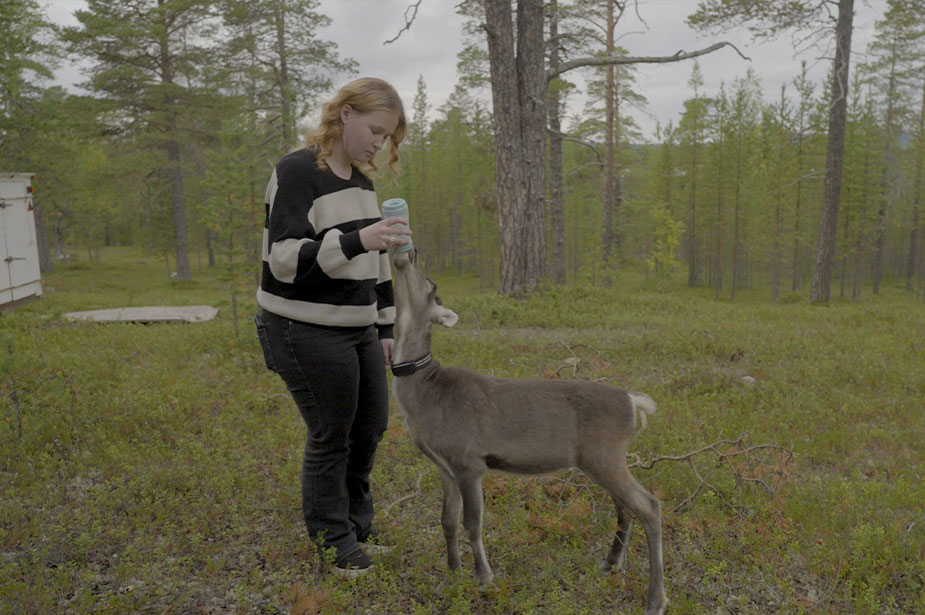
A young Sámi woman feeds a reindeer, belonging to her herding family in Inari, Finland. © OHCHR
For generations, the Sámi people of northern Finland have lived in close connection with the lands and waters of the Arctic north. But as pressures on land and natural resources have grown, many Sámi have worried about the future of their language, traditions and way of life.
For the Sámi, those relationships have never been simple to protect. Reindeer herding, fishing and forestry are not, as Tiina Sanila-Aikio, former chair of the Sámi Parliament, is careful to point out, mere livelihoods.
She said, citing climate change coupled with a myriad of other factors, "for example forestry, tourism, hunting, infrastructure, gold panning, are a huge threat to our culture and language."
The regions where the Sami live are warming more than three times faster than the global average. Frozen and mouldy pastures and extreme snow conditions pose challenges for reindeer and reindeer herders and are threatening the ability of the Sami to continue reindeer herding.
This threat led the Finnish Sámi Indigenous community to seek redress from the international human rights mechanisms. They claimed that the granting of mineral exploration and area reservation permits on Sámi traditional territory violated their rights protected by the International Covenant on Economic, Social and Cultural Rights, among others.
The call was for self-determination, which according to Näkkäläjärvi was not an abstraction. It is having the possibility to influence decision-making, especially a say in what happens to the ground beneath one's own feet.

An aerial view of Lake Inari, Finland. Inari is also known as the known as the cultural and political capital of the Sámi living in Finland. © OHCHR
The community filed three cases, two with the UN Committee on Economic, Social and Cultural Rights (CESCR) and one with the UN Committee on the Rights of the Child (CRC).
“These cases were about the so-called negative human rights obligations of the state not to violate the rights of the indigenous Sámi,” said Martin Scheinin, a Professor of International Human Rights Law.
“In all of these cases, they asked the state to stop mineral exploration on their reindeer herding lands, which in the age of climate change are vulnerable to external threat, even without encroachments by the state,” he said. “There is another dimension of human rights, so-called positive human rights obligations of the state, which are about the state's role in protecting and delivering, fulfilling human rights.”
For almost 25 years, Sámi communities have been bringing their case before United Nations human rights mechanisms, drawing on the protections set out in the two Covenants, as well as other international treaties.
Scheinin, who is also a human rights law scholar, was among those who helped translate a way of life into the language of law.
"The local Sámi reindeer-herding community wanted to enjoy their own culture and transmit it to new generations of young Sámi growing up in the Sámi way of life,” he said.
The legal vocabulary that carried that claim forward, he said, drew on provisions concerning culture, self-determination, identity, non-discrimination, participation, and health.
Following the cases submitted to the Committee on Economic, Social and Cultural Rights, this Committee requested the postponement of the mining exploration. As a result, the projects were immediately suspended.
In landmark decisions, this Committee found that Finland had violated the cultural rights of Sámi communities in matters affecting their traditional way of life and effective participation in decisions concerning their lands. The ruling also brought for the first time the issue of self-determination as a justiciable right and Indigenous Peoples’ rights over their traditional land.
The findings contributed to growing momentum for legal reform to strengthen Sámi self-determination. This, along with previous decisions adopted by the Human Rights Committee (CCPR) and the Committee on the Elimination of Racial Discrimination (CERD), concerning the criteria for entering the Sámi Parliament’s electoral roll, culminated in the 2025 amendment of the Sámi Parliament Act.

Pirita Näkkäläjärvi, Sámi Parliament's current president in Finland, and a prominent advocate for indigenous self-determination and human rights. © OHCHR
Pirita Näkkäläjärvi, Sámi Parliament's current president, has lived the arithmetic of that struggle personally.
"We had already been fighting for this for nearly 25 years, and it took us another six years to get it finished,” she said.
Really, without the Covenants and the treaty body recommendations, we couldn't have amended the Sámi Parliament Act here in Finland. That is a fact.
Pirita Näkkäläjärvi, Sámi Parliament's President
Näkkäläjärvi is quick to see the reform inside something larger than a single legislative victory.
"It reminds us that in all of these struggles where we are fighting for self-determination as an Indigenous Peoples, in the end it boils down to the question of rights to lands and waters," she said.
Sámi self-determination, as she described it, is inseparable from the transmission of Sámi culture to the next generation, the languages, the traditional livelihoods, all of it dependent on the ability to use the land and water as an Indigenous Peoples.
In addressing what Sámi self-determination means in practice the Committee on Economic, Social and Cultural Rights, (CESCR) looked into traditional land resources, livelihoods, legal recognition of indigenous land rights.
“What the Committee added was to translate Sámi self-determination into concrete obligations concerning land, resources and cultural survival,” said Ludovic Hennebel a member of the CESCR.
Hennebel added, “It made clear that reindeer herding is not simply an economic activity: where it sustains culture, community and the transmission of knowledge, protecting the livelihood means protecting the culture itself. And it moved the issue from consultation as a procedural formality to effective participation based on free, prior and informed consent, backed by legal recognition of traditional land rights.”
This year marks the sixtieth anniversary of the two International Covenants, and the Sámi experience is, in miniature, an argument for what such instruments are for.
"The Covenants affect people's lives in countless ways," said Wan Hea Lee, a senior Human Rights Officer at UN Human Rights. "When the Covenants are ratified and incorporated into national law, those rights become rights that people in those countries can invoke and insist be implemented.”
Lee said they can become powerful tools for advocacy for positive change, as well as tools for enforcement through the legal systems.
“It is a quietly radical claim: that a treaty signed in 1966 can still, six decades later, stay relevant,” she said.
“These cases show the tangible impact that human rights complaints mechanisms can have by turning the promises of treaties into lived realities for individuals and communities,” said Dina Rossbacher, a senior Human Rights Officer at UN Human Rights.
Sanila-Aikio looked out over the river and reflected on the struggle of Indigenous Peoples.
"Indigenous Peoples living all around the world — there are very many things threatening our future,” she said. “Our culture, languages and way of life, livelihoods, are precious for us, and I would like to see the states of ours making real efforts toward our future."
For now, though, there is a chef standing in a river that has fed his family for generations, still able to say that the tradition is alive. Whether the fish return to twelve kilos again is not something any court can order. But that Heikki Nikula is allowed, in law, to fish freely, at least, the Covenants helped secure.
Watch this video to learn more about how the Sámi people have championed their rights.
Your donation protects the essentials we all rely on.