 Welcome to the United Nations

 OHCHR


Funding Trends
About Us
-
About UN Human Rights
- Mandate
- Mission
-
The High Commissioner
- Volker Türk, High Commissioner
- Awa Dabo, Deputy High Commissioner
- Claudia Fuentes Julio, Assistant Secretary-General
-
Past High Commissioners
- Michelle Bachelet Jeria, Chile, 2018-2022
- Mr. Zeid Ra'ad Al Hussein, Jordan, 2014-2018
- Ms. Navanethem Pillay, South Africa, 2008-2014
- Ms. Louise Arbour, Canada, 2004-2008
- Bertrand Ramcharan (Acting High Commissioner)
- Mr. Sergio Vieira de Mello, Brazil, 2002-2003
- Mrs. Mary Robinson, Ireland, 1997-2002
- Mr. José Ayala-Lasso, Ecuador, 1994-1997
- Past Deputy High Commissioners
- Past Assistant Secretaries-General
- Global Leadership Team
- What we do
- Where we work
-
Funding and budget
- Our donors
- Funding trends
-
Trust funds
- Special Fund of the OPCAT
- UN Voluntary Fund for Indigenous Peoples
- UN Voluntary Fund for Technical Cooperation
- UN Voluntary Fund on Contemporary Slavery
-
UN Voluntary Fund for Victims of Torture
- About the Fund’s assistance for victims
- Board of Trustees
- How the Fund is managed
- Reports
- Activities
- Survivor and Practitioner Profiles
- International Day in Support of Victims of Torture
- Videos
- Feature stories
- How to apply for an annual grant
- Annual grant cycle
- How to report on a grant
- Emergency grants
- How to contribute to the Fund
- Group of Friends
- Evaluation
- Memorial
Expenditure
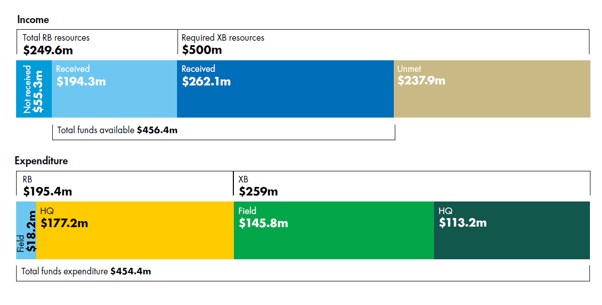
In 2025, 48.4 per cent of total expenditures (US$454.4 million), including regular budget and voluntary contributions, were allocated to fieldwork and work carried out at headquarters to support the field, particularly in relation to capacity- strengthening projects and human rights monitoring. These activities were predominantly financed through voluntary contributions.
Approximately 63 per cent of all extrabudgetary funding was used to support work in the field, which receives minimal support from the regular budget. The remainder of the voluntary funding was distributed between other areas of OHCHR’s work and often supplemented the limited resources that were provided by the regular budget.
Regular budget and voluntary contributions
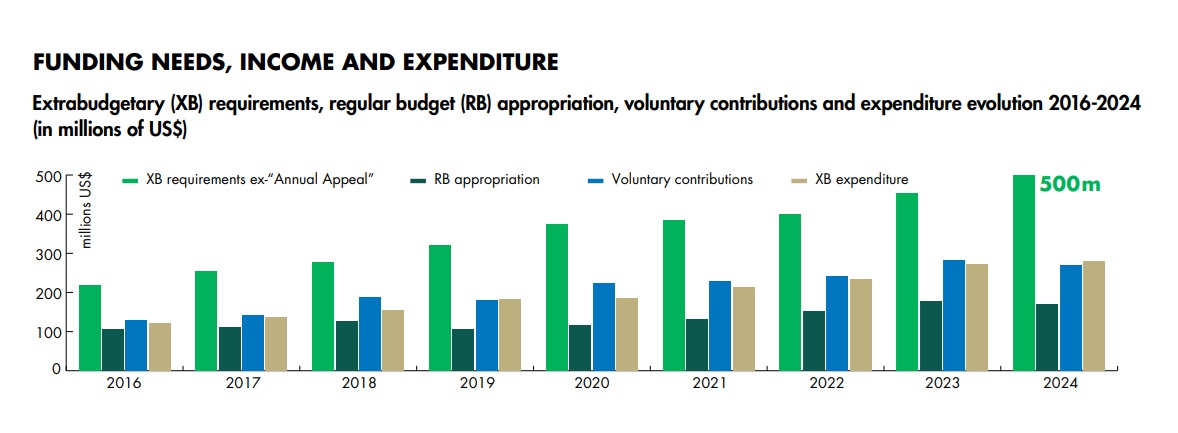
Over the last 10 years, an average of approximately 40 per cent and 60 per cent of the funding for UN Human Rights came from the United Nations regular budget and from voluntary contributions, respectively. In the past several years, the increased share of the United Nations regular budget for UN Human Rights activities came from additional resources that were allocated to cover the human rights treaty body strengthening process. These were based on entitlements of the resource formula of General Assembly resolution 68/268 and additional mandates, including the commissions of inquiry that were established by the HRC.
Funding partners/donor base
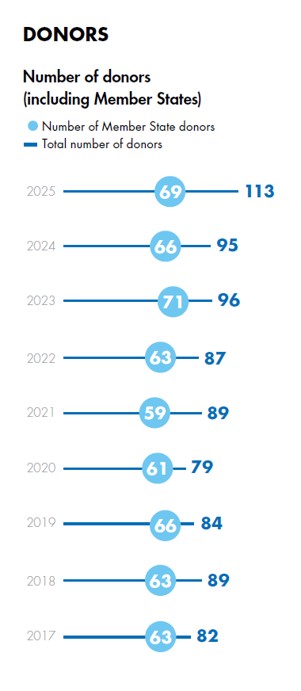
In the context of a sharp decrease in global Official Development Assistance (ODA) and an economic downturn, OHCHR maintained strong engagement with its partners and requested support from its existing and potential partners. In 2025, OHCHR had 113 funding partners, the highest number of funding partners it has had in its history. Moreover, the number of non- Member State partners totalled 44, including 10 new partners, representing the highest number to date.
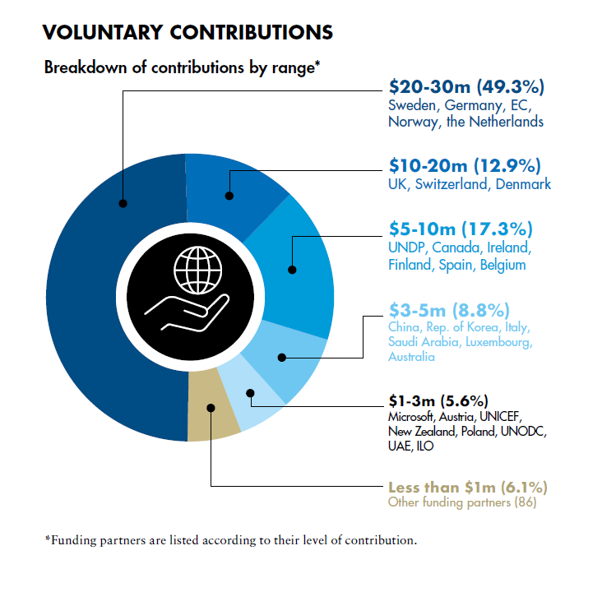
Despite these achievements, nearly 50 per cent of total contributions were provided by five partners. Notably, with regard to regional groups, five Member States of the African Group provided funding in 2025, compared to an average of 2.75 since 2017.
In 2019, the Funding Compact was established by Member States and members of the United Nations Sustainable Development Group (UNSDG), including UN Human Rights, to ensure that more predictable and flexible funding is available to UN development activities for the implementation of the 2030 Agenda for Sustainable Development. In line with the Funding Compact, the 2025 contributions received by UN Human Rights through the inter-agency pooled funds and trust funds amounted to US$9.8 million.
The Funding Compact calls for Member States to increase their multi-year commitments. UN Human Rights began 2025 with only US$74.9 million in predictable and sustainable income from pledged contributions, which were annual instalments of multi-year funding agreements. During the year, UN Human Rights concluded multi-year funding agreements with 15 donors, including 12 Member States (Australia, Austria, Belgium, Canada, Denmark, Finland, the Netherlands, Norway, Qatar, Sweden, Switzerland and the United Kingdom of Great Britain and Northern Ireland), the European Commission and two other donors (Belgique/Fédération Wallonie-Bruxelles and the Open Society Foundations). As of the beginning of January 2026, US$86.9 million had been registered by 23 donors as part of multi-year agreements
In-kind contributions
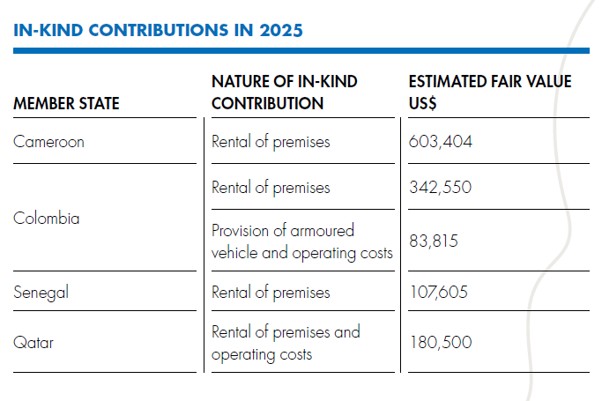
A number of Member States host UN Human Rights offices and provide in-kind support by covering certain costs, including the rent of premises, utilities and vehicles. These contributions are credited to their assessed contributions to the United Nations regular budget.
Earmarked versus unearmarked contributions
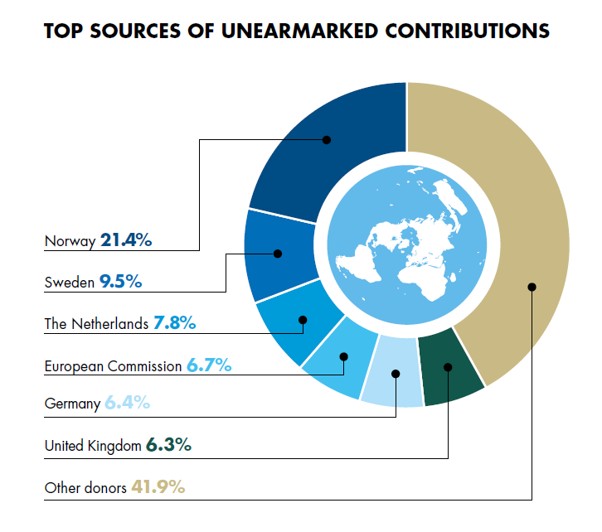
In terms of funding flexibility, 58 per cent of unearmarked contributions were provided by six partners.
Junior professional officers and united nations volunteers
Some Member States provided indirect financial support to UN Human Rights by contributing to the United Nations Junior Professional Officers (JPO) Programme, which is administered by DESA, in New York. As of 31 December, 33 JPOs were working at UN Human Rights and being supported by 18 Member States. The Netherlands also funded JPOs who were nationals of developing countries.
UN Human Rights benefited from indirect financial support through the United Nations Volunteers (UNV) Programme, which is administered by UNDP. As of 31 December, there were 34 UNVs working with UN Human Rights who were fully funded by nine governments. One of those individuals was a non-national.
UN Human Rights also benefited from support through the gratis personnel non-staff support modality. In 2025, seven experts were working at UN Human Rights, assisting with the implementation of technical cooperation activities and contributing expertise with regard to specialized functions that were not available within the Organization.