Welcome to the United Nations

 OHCHR


Report
Call for Input – Transforming food systems to protect human rights and prevent climate harm
Issued by
Special Rapporteur on climate change
Issued by Special Procedures
Subject
Climate change
Symbol Number
A/HRC/62/44
See available official languages
Note: During the maintenance of the Official Document System, the report can be found in the United Nations Digital Library.
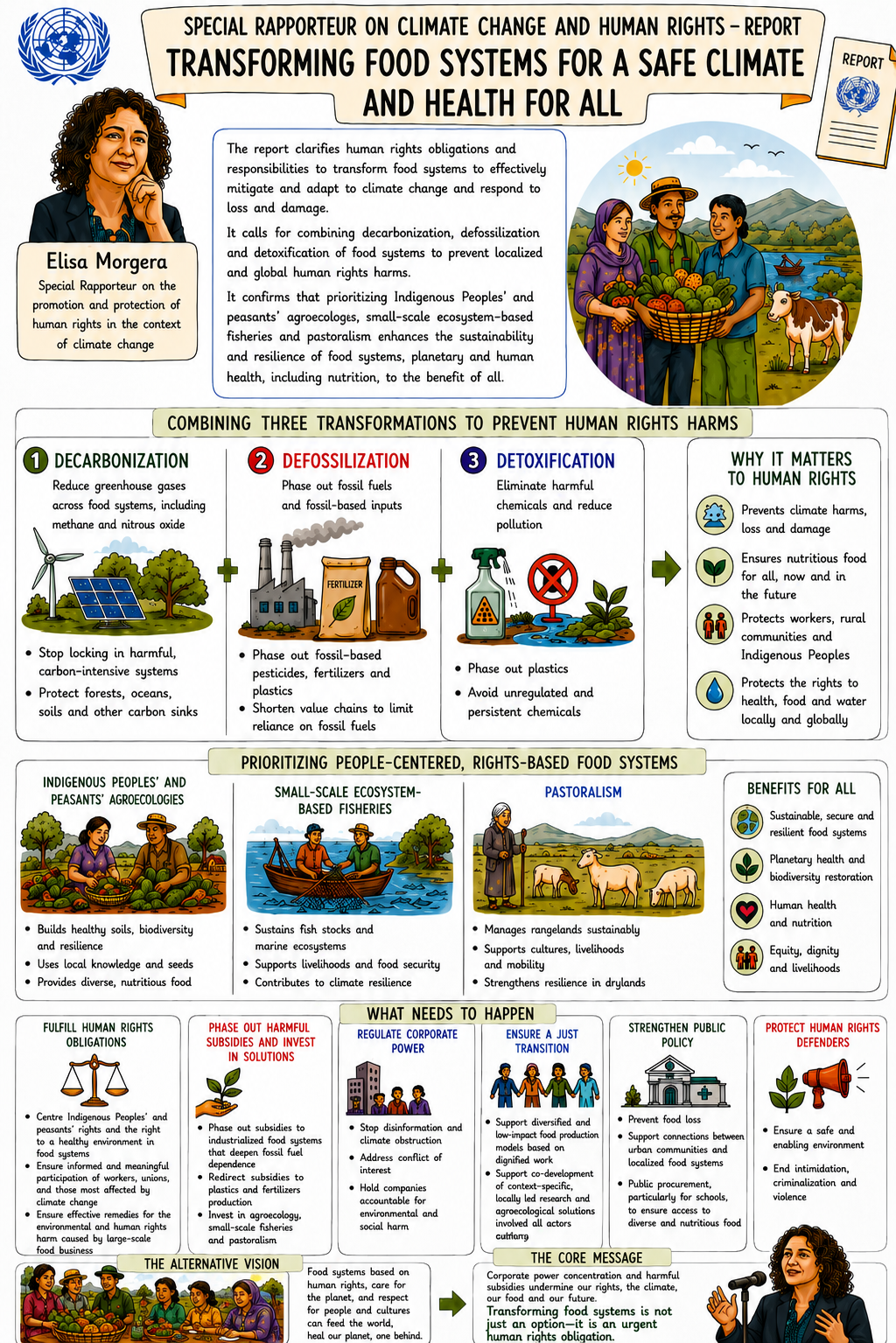
Reader friendly Summary – Transforming Food Systems for a Safe Climate
Reader friendly Summary – Transforming Food Systems for a Safe Climate - Child friendly version
English:
Methodology
English:
Relevant Practices
English:
Further insights from submissions and independent research
English:
Consultas a Niños, Niñas y Personas Jóvenes
Español:
According to the 2025 Lancet Commission’s Report on Healthy, Sustainable, and Just Food Systems, food systems currently account for 30% of total greenhouse gas emissions globally, and transforming food systems could cut emissions by more than half. In addition, food systems are the largest contributor to the transgression of five planetary boundaries, with fewer than 1% of the world’s population currently in a situation where their human rights and food needs are met within planetary boundaries. The report also underscores that the wealthiest 30% of people drive more than 70% of food-related environmental impacts, including climate change impacts.
Recent reports by the Office of the High Commissioner for Human Rights on the impacts of climate change on food systems have identified measures for minimizing adverse impacts, pathways for human rights-grounded minimization of the adverse impact of climate change on food and for a human rights-based transformation of food systems that mitigate climate change. These reports stressed that these pathways are the only way to prevent “catastrophic impact of climate change on food production, … climate-related hunger, stunting and starvation”, as “the reduction of fossil fuel emissions alone – however significant – will not be sufficient to meet the goals of the Paris Agreement” without transforming food systems. Reports by the UN Special Rapporteur on the Human Right to a Healthy Environment (A/76/179) and by the UN Special Rapporteur on the Right to Food have clarified the linkages between climate change and agriculture (A/70/287) and fisheries (A/HRC/55/49), including in the context of the continued expansion of fossil fuels.
In her report to the Human Rights Council in 2025, the Special Rapporteur on Climate Change and Human Rights started to identify linkages between the human rights imperative of defossilizing our economies and food systems, in relation to continued dependency on fossil fuels, plastics and petro-chemicals. In order to advance the clarification of the human rights-based approach to climate action and just transition (A/HRC/60/52), in her upcoming report to the Human Rights Council in 2026, the Special Rapporteur seeks to synthesise and analyse a varied body of evidence (from across the natural and social sciences, including Indigenous science, traditional knowledge and other knowledge systems) of the actual and potential contributions of transforming food systems to climate change mitigation, adaptation, prevention and responses to loss and damage, and human rights protection, taking an integrated approach to land- and ocean-based food systems.
The report will seek to clarify States’ international human rights obligations, individually and as part of international cooperation, as well as business responsibility, to support a just transition in the context of food systems, both land- and ocean-based, while enhancing the protection of everyone’s human rights in the context of climate change. The obligations will be clarified giving due consideration to: the need to scale up global action and support in addressing climate change, including in averting, minimizing and addressing loss and damage associated with the adverse effects of climate change; and the objectives and principles of the United Nations Framework Convention on Climate Change, including the principle of equity and common but differentiated responsibilities and respective capabilities, in the light of different national circumstances and in the context of sustainable development and efforts to eradicate poverty, as interpreted by the International Court of Justice in its 2025 Advisory Opinion on State obligations on climate change. The report will also benefit from the complementary clarifications provided by the Advisory Opinions of the International Tribunal for the Law of the Sea and the Inter-American Court of Human Rights.
The report will identify good practices, strategies and policies, as well as lessons learnt and continuing or new challenges, at all levels vis-à-vis the promotion and protection of all human rights and poverty alleviation in land-based and ocean-based food systems, with a view to contributing to the achievement of the Sustainable Development Goals, in particular Goals 13 (climate action) and 14 (life below water).
The Special Rapporteur will aim to make constructive and concrete recommendations on human rights-based, gender-responsive, age-sensitive, disability-inclusive and risk-informed approaches to the transformation of food systems as part of a just transition towards a safer climate.
The call for inputs aims at advancing understanding of the documented positive and negative impacts on human rights of the links between food systems and climate change, taking into account both land-based and ocean-based food systems and interactions with fossil fuels and renewable energy. Specifically, the call for inputs aims at advancing understanding of the linkages between the human rights imperative of defossilizing our economies and land-based and ocean-based food systems, including in relation to continued dependency on fossil fuels, plastics and petro-chemicals and how it affects food system at various levels throughout their lifecycle.
Inputs are expected on the most recent scientific advances in understanding the role of food systems (agriculture, forestry, fisheries, aquaculture, livestock) in climate change mitigation, adaptation, and loss and damage, including on tipping points. Inputs are expected to shed light on a diverse body of evidence and alternative approaches that can better support an ecosystem-based and human rights-based approach.
Finally,inputs are expected to share good practices and lessons learned in regulating, monitoring and financing food systems, with a view to protecting all human rights, considering intersectionality and inter-generational equity (A/HRC/56/46), and contributing to the achievement of the Sustainable Development Goals, in particular Goals 13 (climate action) and 14 (life below water). In particular, inputs are expected to share analysis of challenges, risks and impacts of carbon markets in the context of food systems.
The Special Rapporteur would like to invite States, interested individuals, international organizations, independent researchers, non-governmental organizations, Indigenous Peoples, peasants, small-scale fishers, rural workers, and businesses, working on issues related to human rights and climate change, to provide inputs for the preparation of her thematic report. Inputs can be both country-specific or of a general nature. They may contain information on any one of the following subjects (or on a combination of subjects), or also bring to the attention of the Rapporteur additional areas of relevant knowledge and/or experiences of human rights impacts including the overarching below question:
Are there individuals or groups who see their human rights particularly impacted by elements described in the 5 below subsections including in light of intersecting forms of discrimination. Which human rights are the most impacted?
1) The role of food systems in relation to climate change mitigation, adaptation, and loss and damage:
2) Challenges and opportunities to defossilize food systems:
3) Finance and technology:
4) Carbon markets:
5) Nexus planning:
The input will inform the preparation of the thematic report of the Special Rapporteur to the United Nations Human Rights Council.
Unless otherwise specified, the input will be published on the website of the Special Rapporteur. If you would NOT like your written input or any other information to be published on the website of the Special Rapporteur, please explicitly indicate this in your input. In view of consent and privacy issues, contributions containing names of alleged victims will be considered but not published online.
Please note that the deadline has been extended to 30 January 2026.
Association of Reintegration of Crimea
Global Climate and Health Alliance
International Indian Treaty Council
Jamma Conservation and Communities
Sierra Leone Network on the right to food
WECF and MenEngage Alliance - joint submission
Association Études et Développement
Institute for Agriculture and Trade Policy
Rajiv Gandhi National University of Law
Reimagining Food Systems Project: input-1 | input-2
UniversidadCientíficadelSur: input-1 | input-2