 Welcome to the United Nations

 OHCHR


Minority Rights, Equality and Anti-Discrimination Law
OHCHR and minorities
Supporting Comprehensive Equality Law Reform Worldwide
OHCHR’s primary goal in the field of equality and non-discrimination for the period 2024-2027 focusses on advancing efforts to secure the adoption of laws, policies, programmes and practices to combat all forms of discrimination and to address inequalities. A central plank in this effort is supporting comprehensive equality law worldwide.
Introduction video from the High Commissioner
Background
Ensuring equality and combating discrimination are bedrock principles of international human rights law. The right to equality and to non-discrimination is the only right affirmed by all nine of the core human rights treaties. Although progress has been achieved, discrimination and inequality remain widespread and may worsen. UN Human Rights will continue to work to support efforts to counter socio-economic inequalities and regressive anti-rights narratives which reinforce intersecting forms of discrimination and constitute both a trigger and an underlying cause of violence and conflict.
Inequality impairs human dignity, causes and perpetuates poverty and limits the enjoyment of human rights. Inequality is a barrier to participation in economic, social and political life. It restricts the life chances of people and serves to oppress and marginalize entire communities. Beyond the experience of those directly affected, unequal societies are more likely to be beset by health and social problems ranging, with higher levels of incarceration, violence and other social problems, and lower levels of social mobility. Inequality undermines social cohesion and fosters conflict. It exacerbates the exclusion of minorities and other marginalized groups. Above all, it embeds unfairness, with powerful negative consequences for people and communities.
Inequality takes many forms and has myriad causes – economic, social, political and cultural. As such, creating a world in which all can and do participate equally requires a coordinated, collaborative and comprehensive approach. The elimination of discrimination is a key part of this puzzle: there can be no equality where people are treated unfavourably or subjected to disadvantage on the basis of their status, their beliefs or their identity. Indeed, this has been widely and consistently recognized by states, through their adoption of international human rights instruments which place the right to non-discrimination at their heart.
The adoption of comprehensive anti-discrimination laws—laws which have the purpose and effect of prohibiting all forms of discrimination—is an essential step in the effort to realize the right to non-discrimination. Without the enactment of laws which prohibit all forms of discrimination on the basis of all grounds recognized in international law in all areas of life regulated by law, provide for the effective enforcement of the right, and mandate positive action measures to address historic or structural discrimination, states will be unable to give effect to the right to non-discrimination. It is only through ensuring the legal protection of the right to non-discrimination that states will realize their ambitions to combat inequality.
Comprehensive anti-discrimination laws have the potential to transform people and societies. Since the 1990s, governments, the human rights mechanisms, human rights defenders, and people exposed to discrimination, have come together to call for the enactment of comprehensive equality laws. In this regard, we assist States to enact comprehensive anti-discrimination laws and to develop independent equality bodies. This is done through methodological and normative guidance to governments, parliaments, National Human Rights Institutions, civil society and human rights defenders, to understand the scope and content of the requirement to establish national protection systems against all forms of discrimination.
What are Comprehensive Anti-Discrimination Laws?
Comprehensive anti-discrimination laws aim to advance national-level realization of the right to equality in practice. They are laws which (1) are comprehensive of all grounds recognized in law (ethnicity, religion or belief, sex, sexual orientation and gender identity, disability, age, etc.); (2) cover all areas of life (work, housing, health care, justice and security systems, political participation, etc.); (3) include certain legal innovations – central among them the shifting or sharing of the burden of proof, where the complainant brings plausible indications that discrimination may have taken place; and (4) establish a national entity – an “equality body” – empowered to act as national focal point for equality law matters, including the adjudication of cases of discrimination.
In detail, these laws:
• Prohibit all forms and manifestations of discrimination on the basis of an extensive and open-ended list of grounds and in all areas of life regulated by law.
• Provide explicit definitions of all forms of discrimination that are consistent with the definitions recognized under international human rights law.
• Explicitly permit, require and provide for the adoption of positive action measures designed to make progress towards the realization of equality for persons exposed to discrimination.
• Operationalize the rights to equality and non-discrimination within the public and private spheres by ensuring accessibility and establishing equality duties.
• Provide for effective remedy, including sanctions that are effective, dissuasive and proportionate; recognition, compensation and restitution for survivors; and relevant institutional and societal remedies.
• Establish the necessary procedural safeguards and adjustments to ensure access to justice, including, but not limited to, provision for the shifting of the burden of proof after a prima facie case of discrimination has been made by a complainant and provision for the prohibition of victimization.
• Provide for the establishment of an independent, specialized equality body with sufficient resources, functions and powers to ensure its effectiveness.
• Mandate the adoption of other implementation measures necessary to address structural discrimination and make progress towards equality.
Worldwide, comprehensive anti-discrimination laws – when done correctly and with a view to ensuring access to justice for victims – have proven to be an overwhelmingly positive instrument – both for victims of discrimination and for society-at-large. They additionally contribute to both enabling civic discussion of issues often deemed sensitive or difficult, as well as educating the public about the value and meaning of diversity in a democratic society.
These laws constitute a floor, not a ceiling. They are a baseline requirement in the area of the right to equality and non-discrimination. Certainly, other measures are also needed in order to guarantee the right to equality and non-discrimination for all people. However, in practice, it is effectively impossible for a UN Member State to comply with its international law obligations in the area of equality and non-discrimination without the adoption and implementation of comprehensive anti-discrimination laws.
In 2023, jointly with the London-based thinktank Equal Rights Trust, OHCHR published Protecting Minority Rights: A Practical Guide to Developing Comprehensive Anti-Discrimination Law. The Guide sets under one cover the requirements under international law to adopt and implement comprehensive anti-discrimination law. The Guide was launched at an event at UPEACE in Costa Rica.
Our Guidance: A Practical Guide to Developing Comprehensive Anti-Discrimination Legislation
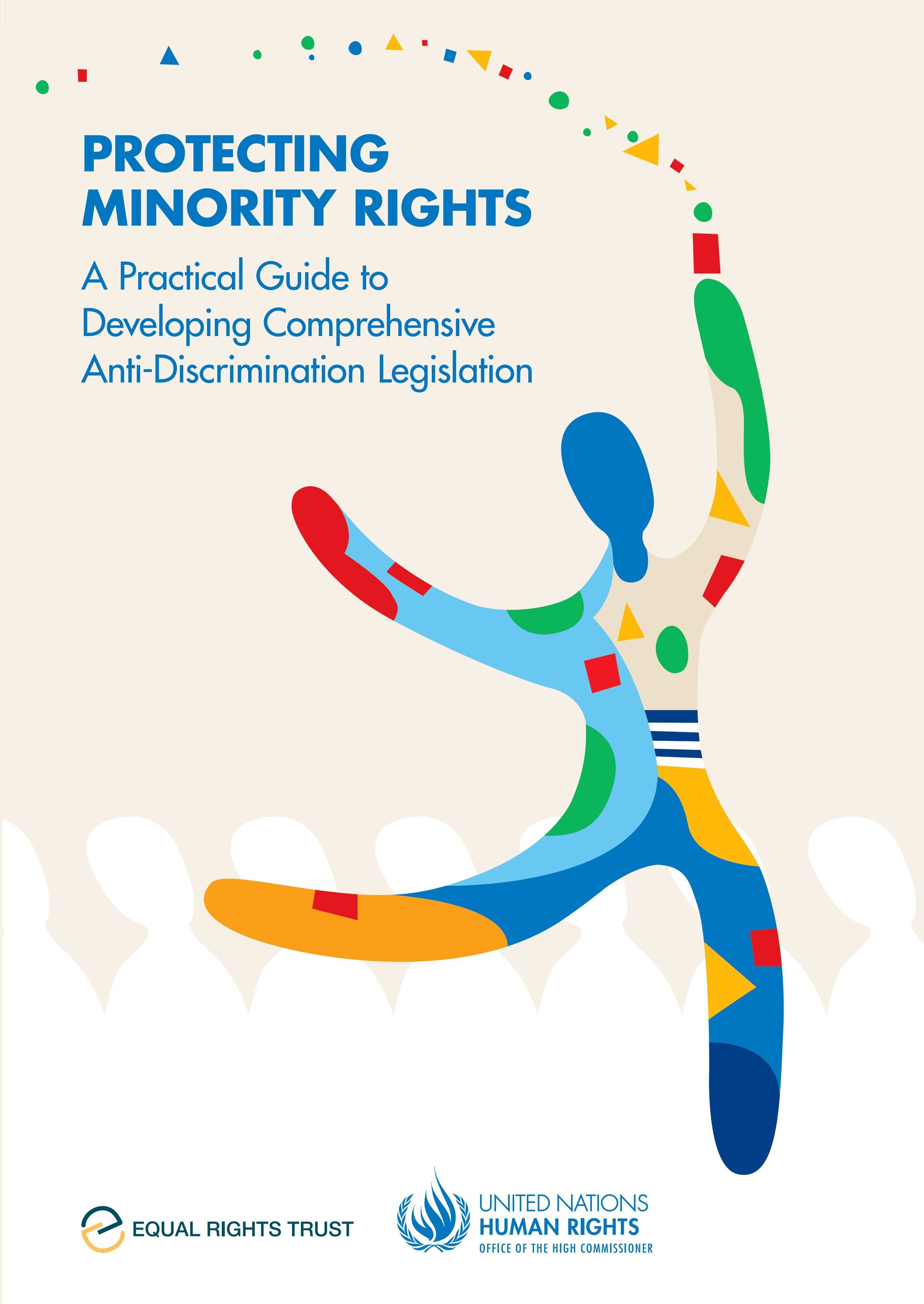
"Protecting Minority Rights: A Practical Guide to Developing Comprehensive Anti-Discrimination Legislation” is the definitive guidance by the United Nations on the laws which states must enact in order to meet their international human rights law obligations to prohibit discrimination.
The Guide was developed by OHCHR in partnership with the Equal Rights Trust, an independent international organisation which works to support the adoption, enforcement and implementation of equality laws. In addition to an exhaustive research process reviewing the content and interpretation of all of the relevant UN human rights convention, the Guide was the subject of extensive global consultation with academic and civil society experts.
The Guide synthesises and harmonises existing international legal standards, to provide clear and accessible guidance on the necessary scope, structure and content of comprehensive anti-discrimination laws – laws which provide the foundation for creating societies where all are equal in dignity and rights and where no-one is left behind. In addition to summarizing normative content, the publication provides concrete country-based practices and practical guidance.
The Guide fills a long-standing gap for clear, unequivocal and comprehensive guidance for Governments, Parliaments, NHRIs, UN staff, civil society representatives and minority and other human rights defenders in the elements of anti-discrimination law, the various aspects of the comprehensive ban on all forms of discrimination and the protection of minorities, as grounded in the core international human rights treaties and related norms and standards, including as adjudicated.
The Guide provides support for everyone seeking to act on United Nations Secretary General Antonio Guterres’s global call, for all of the States of the world to adopt comprehensive anti-discrimination laws.
“Protecting Minority Rights: A Practical Guide on Developing Comprehensive Anti-Discrimination Legislation” is currently available in Arabic, Chinese, Japanese, Korean, Portuguese, Russian and Spanish. Summary materials are also available in French, Greek, Hindi, Kurdish and Turkish.
Download the Guide and the two pagers, and power-point decks summarizing the content of the Guide
Since its publication in 2023, we have worked with government officials, parliamentarians, National Human Rights Institutions, national equality reform movements, and civil society worldwide to review and examine various aspects of the material set out in the Guide, to assist with efforts to adopt these laws. We welcome further contact and initiative. Contact: claude.cahn@un.org
The Equality for All Academic Action Alliance

The Equality for All Academic Action Alliance brings together universities, legal clinics and research institutions – in the field of law and beyond – to support national efforts to adopt and strengthen comprehensive anti-discrimination laws.
The Alliance was launched on 1 July 2025 by OHCHR and partner Equal Rights Trust (ERT) and a group of academics worldwide working on equality and non-discrimination issues.
The Alliance acts as a global network of academic entities committed to supporting the advancement of equality law adoption and reform. Its objectives include:
- Developing a global network of academic entities committed to supporting the advancement of equality law adoption and reform worldwide;
- Conduct efforts to advance the adoption of comprehensive anti-discrimination legislation at national level, including in response to demands from equality law movements;
- Facilitating community engagement, communication and public outreach efforts relating to equality and non-discrimination with grassroots human rights defenders, communities and constituencies worldwide, including online;
- Building and sharing expertise on strategic anti-discrimination work at national and community levels, especially in contexts where there are opportunities for equality law reforms.
The Alliance functions under a provisional Board until 30 June 2026. A fully empowered Board made up exclusively of academic institutions will begin work on 1 July 2026. OHCHR will remain involved as observer. In September 2025, an initial 11 academic institutions were approved and joined the Alliance. The secretariat of the Alliance will be provided by the academic institution acting as Chair of the Board.
If you would like your academic institution to join the Alliance, please complete the short form available here. This form is also available in Arabic, Chinese, French, Russian and Spanish. Please note that membership of the Alliance is open to institutions, not individual academics. Submissions are welcome at any time, and applications will be reviewed quarterly by the Alliance’s board.
A brochure about the Alliance is available here.
The provisional Concept Note guiding the Alliance’s work during the period 1 July 2025-30 June 2026 is available here.
Contacts:
equalityforall.alliance@gmail.com
laura.cahier@un.org
claude.cahn@un.org