 Welcome to the United Nations

 OHCHR


Statements and speeches Multiple Mechanisms
High Commissioner: We need a renewed Helsinki Spirit for global peace and security
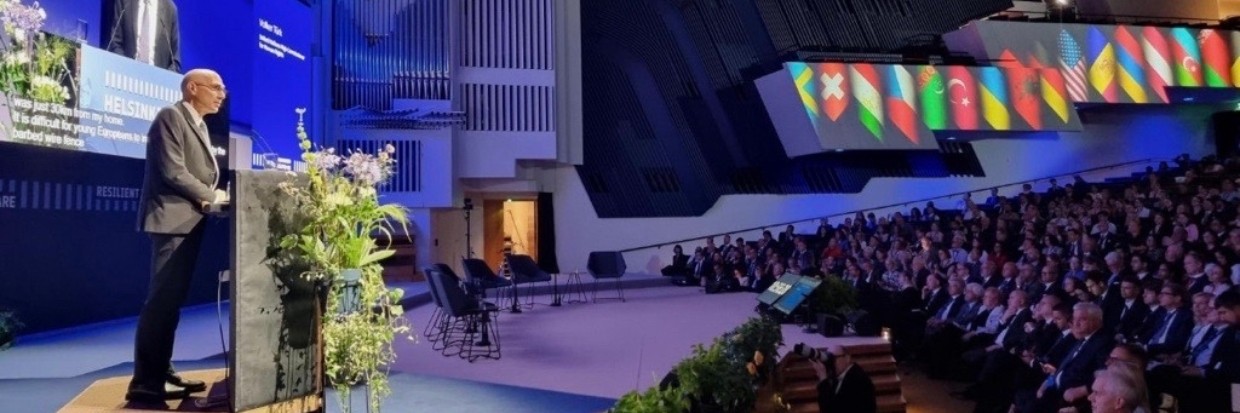
Remarks to the Helsinki+50 Conference: Respecting the Legacy, Preparing for the Future
31 July 2025
Delivered by
United Nations High Commissioner for Human Rights Volker Türk
At
Helsinki, Finland
Excellencies, Ministers, Excellencies Distinguished delegates, dear friends,
It is a great pleasure to be here with you in the beautiful and warm city of Helsinki to mark this important anniversary. I am particularly moved to be in the very hall where the Helsinki Final Act was signed fifty years ago.
Today, amid conflict and crisis, as the world seems more fragmented than ever, I pay tribute to the leaders of the time, from East and West, who came together to sign the Helsinki Final Act here in 1975.
Helsinki has a special meaning for me. I spent my childhood in Vienna and Linz, in Austria, in the shadow of the Iron Curtain. The border between Austria and Czechoslovakia at the time was just 30 kilometres from my home.
It is difficult for young Europeans to imagine how I was haunted by the barbed-wire fence, it’s the watchtowers, the guards, and the guns.
Even as a small child, I knew people had been killed trying to cross the border. And as I grew up, I understood that this eerie No Mans Land embodied a much bigger threat. I would often wake up at night, anxious about the possibility of nuclear war.
When I heard the song “Russians” by Sting, calling for common sense “on either side of the political fence”, I pictured that border. Finally, someone was talking about the simple human emotions that override ideological differences.
In 1985, when Sting recorded “Russians”, the Helsinki process was ten years old, and its influence was growing.
The Spirit of Helsinki encouraged openness and co-operation. States started to inform each other about troop movements and military exercises.
But its most important principle – what set it apart from other treaties – was that the Helsinki Final Act recognized a comprehensive concept of security, including a human dimension that goes far beyond an absence of war.
The Helsinki Spirit put human rights – civil, political, economic social and cultural – at the heart of peace and security. It provided a path out of ideological divisions and towards greater freedoms – freedoms of thought, of expression, of peaceful assembly, of movement, and the right to leave and return to one’s own country.
It gave hope to human rights defenders and dissidents across Europe.
And it focused on ways to unite, rather than divide.
The Helsinki process played an important role during the end of the Cold War. It was a platform for dialogue, based on mutual respect and clear channels of communication. And as the Conference on Security and Cooperation in Europe was transformed into the OSCE in 1990, the cause of advancing human rights was the golden thread that brought its participating States together.
Since 1990, the OSCE has played an important role in promoting stability in Europe, through its work in the Western Balkans, in Transnistria, and in the Caucasus.
You have helped strengthen democracy, advance co-operation, and promote comprehensive security by encouraging, for example, dialogue between parliaments. Your role in observing elections has helped make them fairer and more trustworthy. Your field operations and institutions – the Office for Democratic Institutions and Human Rights, the High Commissioner on National Minorities, and the Representative on Freedom of the Media – play a vital part in the human rights ecosystem in the vast area stretching between Vancouver and Vladivostok.
And now, fifty years after the Helsinki Final Act, powerful forces are at work, undermining multilateralism, flouting international law, and attacking global institutions and frameworks that were painstakingly created over decades for the benefit of all.
This anniversary is indeed an opportunity to revitalize the Helsinki spirit and work for dialogue and solidarity as the foundation of peace and security in Europe and around the world.
Today’s theme, Respecting the Legacy, Preparing for the Future, calls on us not only to celebrate the enduring achievements of the Helsinki Final Act, but to apply their lessons to the challenges of today and tomorrow.
My Office and the OSCE have a strong partnership, through regular meetings and consultations.
We share profound concerns around issues from conflict prevention to media freedom, gender equality, human trafficking, freedom of expression, the human rights impact of the climate crisis, and the protection of the rights of minorities.
The human rights at the heart of the Helsinki process are a roadmap and a compass to rebuild trust and guide us towards solutions.
Human rights are a factor of stability and resilience – and I welcome Finland’s emphasis on resilience during its Chairpersonship of the OSCE.
In our turbulent times, amid high levels of uncertainty and volatility, human rights are the voice of reason and compassion. They counterbalance the empty zealotry of some of today’s leaders, and constrain the abuse of power.
Human rights give us the self-confidence to confront prejudice and to right historic wrongs.
And they are a tool for systemic, sustained change that benefits everyone.
I see three areas for our joint focus in the coming years.
First, respect for human rights helps to prevent conflict and mitigate its impact on civilians.
The root causes of conflict often lie in inequalities and human rights violations, and are fuelled by dehumanization, discrimination, the shrinking of civic space, and the targeting of minorities. We see these dynamics today in Gaza, in Sudan, and elsewhere.
We need to invest much more at the national and global levels in heeding early warnings, and in building peace by investing in dialogue and confidence-building measures.
Human rights also show the way out of conflict – by insisting on accountability, and by putting people at the centre of mediation and peacebuilding.
My Office is working for these goals around the world. Our work raises the alarm, helps to prevent abuses and violations, and documents them when they take place. Let me give you two examples.
In Ukraine, we have detailed the appalling cost of Russia’s full-scale invasion, which has escalated this year with a serious increase in civilian casualties – as we have just heard from the President. My Office has verified repeated patterns of torture and the cruel and inhuman treatment of Ukrainian prisoners in Russian captivity. We also continue to report on Russia’s illegal imposition of its governance system in the territory it occupies, and on the climate of fear created by widespread human rights violations there.
I also want to mention the Occupied Palestinian Territory, where, after the horrific attacks of 7 October by Hamas and other Palestinian armed groups, our reporting has kept a spotlight on the huge numbers of civilian deaths in the Israeli bombardment of Gaza; the repeated forced displacement; the unlawful restrictions imposed on the entry and distribution of humanitarian aid; the killings of people seeking food; and attacks and harassment of Palestinians by Israeli settlers and security forces in the occupied West Bank. It is clear that that war must also end, hostages must be released, Israel must end its unlawful presence – and there must be accountability for all violations of international human rights and humanitarian law.
We are on the ground in conflict and crisis situations – I’ve only mentioned two – including Sudan, Myanmar, Haiti, and beyond.
This is detailed, meticulous work that shines a light on abuses and violations that would otherwise remain hidden.
As a second area for our joint focus, human rights provide a lens to tackle the climate crisis and protect people from its impact. When we look to the future, we know the climate crisis will be one of the biggest multipliers of security risks, especially around competition for water and other resources.
The extraction and burning of fossil fuels are trapping humanity in a furnace. And the countries and people that contributed least to global heating are suffering its worst effects.
Human rights call for justice. Those responsible for the climate crisis need to pay up. We need new, creative sources to fund climate action, and a serious reform of the global financial architecture so that all countries can access the finances they need.
The recent Advisory Opinion issued last week by the International Court of Justice on the obligations of States’ regarding climate change affirms what many of us have long argued: Governments have a clear human rights obligation under international law to address the climate crisis.
Third, respect for human rights is the best guarantee for progress in every society. Creativity and innovation are not possible without free speech, dissent, the right to peaceful protest, academic freedoms and respect for science.
But today, more and more Governments in every region are cracking down on these freedoms. It is frightening to see that the tools of repression are back with a vengeance, in places we would never have expected to see them.
Human rights activists, lawyers, journalists and civil society groups are threatened, harassed, and targeted by disinformation. Some Governments are using new technologies to reach across borders to intimidate, abduct, and even kill opponents and critics.
Meanwhile, poorly regulated social media platforms are silencing some people and communities. Women and girls, people with disabilities, and minorities of all kinds suffer disproportionate harassment and abuse online.
We need an open public space for debate, backed by free and independent media – and I welcome Finland’s decision to prioritize gender equality, inclusion, and engagement with civil society, as the Minister just mentioned.
Fifty years on, this is an important opportunity to revive the Helsinki spirit and the principles of the OSCE.
The need for cross-border cooperation on building sustainable peace and security, and protecting all human rights, has never been greater.
For the world to move forward together in peace, we must heed the lessons of the past, with Helsinki at their heart.
Thank you.