 Welcome to the United Nations

 OHCHR




Human rights don’t protect themselves.
Your donation protects the essentials we all rely on.
22 October 2025

“The message is clear. Without justice, there is no peace. Without strong institutions, there's no lasting development. And without human rights, there is no SDG16,” said Claudia Fuentes Julio, Chile’s Ambassador to the UN in Geneva, Switzerland. “SDG16 is the cornerstone of the entire Agenda.”
Fuentes Julio spoke at a Human Rights Council side event to launch the latest report on the progress of Sustainable Development Goal 16 (SDG16), of which UN Human Rights, the UN Office on Drugs and Crime, and the UN Development Programme (UNDP) are co-authors.
SDG16 focuses on promoting peaceful and inclusive societies, providing access to justice for all, and building effective, accountable and inclusive institutions at all levels. Nearly a decade into implementation, the report’s data show that not a single target under Goal 16 is fully on track.
Alongside the Chilean Ambassador, the lineup of speakers included UN Human Rights Chief Volker Türk; Agi Veres, Director at UNDP’s Geneva office; Belize’s National Statistical Office Director-General Diana Castillo; Gemma Parojinog, Director of the Philippines’ Commission on Human Rights; Nyang’ori Ohenjo of the Centre for Minority Rights and Development (CEMIRIDE) in Kenya; and Anwar Mahfoudh, Chief of the Innovation and Analytics Hub at UN Human Rights.
“According to recent data, on average, one civilian is killed in conflict every 12 minutes. One human rights defender or journalist is killed or disappears every 14 hours,” Türk said.
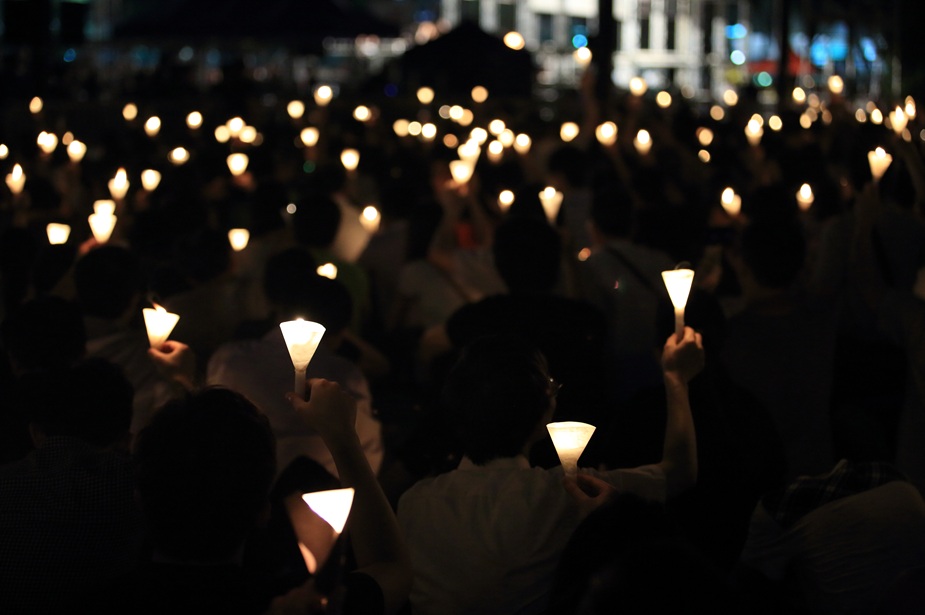
A candlelight vigil for peace. © Getty Images / LewisTsePuiLung
Veres said that in terms of loss of lives there’s a 40 per cent increase from 2023, with over 48,000 deaths.
“Civilians pay the highest price,” she said. “Women and children were disproportionately affected, and child casualties quadrupled in just two years.”
According to the report, lack of progress on SDG16 has been driving forced displacement, with 123.2 million people fleeing conflict, persecution and other human rights violations in 2024, up more than 50 per cent since 2020. Mass displacements cannot and will not end unless there is peace.
Beyond battlefields, lethal violence is persistent. According to the report, since 2015, the global homicide rate edged down from 5.9 to 5.2 per 100,000, but progress is short of the target of a 50 per cent reduction by 2030.
And the toll is gendered. Almost 60 per cent of all women intentionally killed in 2023 were killed by intimate partners or family members, roughly one woman every 10 minutes.
The geography of risk matters too. Latin America and the Caribbean still have the highest homicide rate (19.7 per 100,000), with Sub-Saharan Africa also elevated (estimated 11.9), while parts of Asia are far lower. This shows that targeted prevention and justice strategies work when sustained.
“Even countries who are not experiencing high levels of violence or unrest are impacted,” Castillo said. “For some of us, this means that we can become receivers of refugees and displaced persons. And at the very least rising cost of living that is driven by ongoing conflicts touches us all, even if we think that it doesn’t.”
“We are seeing rising discrimination; persistent pre-trial detentions; increasing violence — including sexual violence, often targeting women and children — and growing barriers to justice for victims,” Türk said. “Most people feel they don’t have a voice in government decisions.”
The report underlines that justice depends upon equal enjoyment of rights and access to remedies and systems that are accessible, fair and responsive to the needs of all.
The data show why this matters now: the global prison population reached 11.7 million in 2023, with one-third held in pre-trial detention, a sign that due process is lagging.
Parojinog said that in the Philippines, the Commission on Human Rights conducts its own investigations.
“We monitor and assess the human rights situation […] and propose evidence-based, data-backed measures and legislation,” she said.
She noted that the Commission is the official data provider for SDG indicator 16.10.1, and that work has been done that aims to fully integrate the data of the Commission as the national data provider with the Philippines Statistics Authority system.
Challenges remain she said, such as red tagging, which is labelling of individuals or organizations in the Philippines as communists, enforced disappearances and extra-judicial killings, which complicate data sharing.
Fuentes Julio said that transitional justice is not optional but essential for reconciliation and sustainable peace and called for justice systems that are not only accessible, but fair and accountable.

Statue of Lady Justice, symbol of fair treatment under the law. © Getty Images / busra İspir
Echoing the report’s emphasis that without data we are left with blind spots, Castillo highlighted the role of national statistical offices in collecting the data that shows where to focus efforts so resources for SDG16 reforms are deployed efficiently. She presented her organization’s groundbreaking work on measuring discrimination, supported by the Praia City Group of the United Nations Statistical Commission and UN Human Rights’ guidance for SDG indicator 16.b.1.
Türk said there’s a need for national statistical offices and human rights institutions to work together on high-quality, timely and disaggregated data. Veres said that while it’s promising that the number of national human rights institutions rose from 70 in 2015 to 89 today, they must be expanded and strengthened.
The Philippines’ Commission on Human Rights (CHRP) showcased how a national human rights institution can strengthen human-rights protection into official statistics and practice. These actions include the adoption of methodologies for estimating SDG16, and CHRP has chaired the development of common definitions for corrections statistics to safeguard the rights of persons deprived of liberty. These steps strengthen the pipeline from case documentation to policy and accountability.

A group of people work around a screen with statistical data. © Getty Images / Kindamorphic
Ohenjo emphasized the operational essentials that make institutions responsive in Kenya.
“Where data was lacking, it was very difficult to get to know how to intervene, where to intervene. Where is the prevalence?” he said.
He flagged that data protection concerns are some of the challenges, and so is the risk of data duplication across different organisations, but also that information coming from civil society organizations can be an opportunity.
Türk reiterated the advances in these countries and said that in Kenya, collaboration has improved the visibility of intersex people, stateless people, Indigenous Peoples and people with albinism.
“In the Philippines and beyond, national human rights institutions have been recognized as sources of official data on attacks against human rights defenders, leading to stronger protection,” he added.
Türk said that we cannot move in the dark.
“This is where data comes in,” he said. “It lights the path out of chaos, helping us act quickly and effectively. Above all, we must innovate for human rights.”
“And my Office is putting this vision into practice with the development of our Human Rights Data Exchange (HRDx) the world’s first comprehensive human rights data service,” he said. “HRDx will bring fragmented information together into a single, reliable platform, reflecting the interconnectedness of all SDGs and the indivisibility of human rights.”
Mahfoudh explained that HRDx will make it easier than ever to access data, explore insights and act on human rights issues through intelligent assistants, interactive visuals and maps.
HRDx will enable action, strengthen accountability and equip people with the insights needed to safeguard their rights.
Anwar Mahfoudh, Chief of UN Human Rights’ Innovation and Analytics Hub
“This is about moving from approaches that no longer serve today’s complex realities,” Mahfoudh said. “This vision is aligned closely with the spirit of SDG16, particularly in its emphasis on data exchange and partnerships.”
For him, the progress report is a reminder of how agile human rights work needs to be. HRDx can only help accelerate that progress, he said.
“This is UN 2.0 in practice: harnessing innovation, partnerships, and foresight to deliver solutions that work for all,” Türk said.
He concluded by urging States to prioritize human rights in their work on SDG16 and across the 2030 Agenda.
Human rights are the best chance to deliver in the time we have left.
UN Human Rights Chief Volker Türk
VIEW THIS PAGE IN:
Your donation protects the essentials we all rely on.