 Welcome to the United Nations

 OHCHR




Human rights don’t protect themselves.
Your donation protects the essentials we all rely on.
09 January 2026

When a massive explosion tore through the port of Beirut on 4 August 2020, killing more than 200 people, injuring thousands of others and devastating large parts of the Lebanese capital, Marina El Khawand was faced with making a decision that would change her life.
At just 18 years old, the law student who had dreamt of becoming a human rights defender was urged by her family to leave the country. Lebanon was plunging into overlapping economic, political, and healthcare crises following the 17 October Revolution, the COVID pandemic and the blast in Beirut. Instead, she urged her family to let her stay.
“I had to fight or flight. I chose to fight,” she said. “It was hard and, to this day, I choose to fight. But it's been hard and it's getting harder.”
Before the explosion, Lebanon, El Khawand said, was often described as the “Switzerland of the Middle East”, known for its healthcare system that attracted patients from across the region.
“We lost the country's force, its heartbeat, when many individuals left and flew away,” she said, adding that the deepening crisis had pushed the country hundreds of years backwards.
In the days following the blast, El Khawand, who recalled being part of the Scouts Movement as a child, began volunteering to help those affected, carrying only “a bottle of water and a backpack.” A week later, against peer advice and without alerting anyone, she decided to drive deeper into the affected zone where most first aid workers had not ventured.
“It was as if I was walking into a history book. My family had told me about the war, how they had bombed next-door buildings and neighbours were killed, and this looked like a war zone.”
She came to the front of a building, “ashes to the ground,” guarded by three women trying to secure what remained of their families’ homes. They told her they did not need help but rather an older woman was trapped inside and needed assistance. El Khawand entered the unstable structure alone, wondering what she would do if she found the woman deceased. The woman was sitting on a chair, pale and with her eyes closed, but her chest was going up and down. El Khawand noticed she was clutching a purple inhaler, the same medication her mother used to treat her asthma.
El Khawand went to several nearby pharmacies, but the medication was unavailable. After hours of searching and asking herself how she was living in a country where she could not find that medication, she turned to Instagram, posted a photo of the inhaler and asked for help. A Lebanese influencer shared the post and within a couple of hours she called El Khawand with news that she had sourced six boxes locally and another six through a Lebanese pharmacist abroad.
She returned to the woman with the medication.
“The moment when she saw the medications in my hand, she started crying. This shook me, seeing an older lady, the same age as my grandma, crying because she saw her medication, her basic rights, her basic right to health. It was the happiest and saddest moment for me,” El Khawand said.
“She whispered in my ear a sentence that started Medonations: “Thank you for saving my life”.” She repeated this sentence and then I knew this was my purpose in life,” El Khawand said. “I want to live; I want to wake up every single day just for one mission: to save lives.”
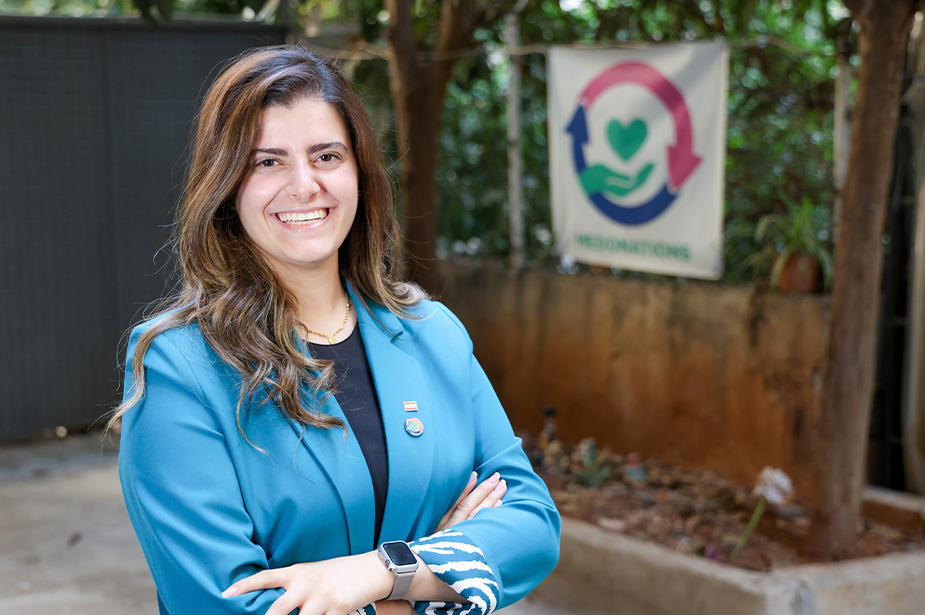
Marina El Khawand, a social entrepreneur and healthcare innovator, founded Medonations after the explosion in Beirut in August 2020 to collect and distribute medications to patients in need. © Young Activists Summit
What began as a spontaneous response to an emergency for El Khawand soon became an international movement. Medonations was formally registered in Lebanon as a non-profit in 2021, then registered its first HQ in Europe, in France, in 2023. El Khawand and her team operate across 65 countries and provide people living in Lebanon with medicines and healthcare support and have so far reached more than 25,000 beneficiaries. The organisation connects with doctors, pharmacists, nurses and volunteers worldwide.
“All the individuals that we attracted during our mission have common values. They only have one mission: health equity for everyone and healthcare access for everyone, regardless of nationality, religion, race, gender, or anything,” she said.
Alongside humanitarian work, El Khawand, now 24 years old, focuses on long-term systemic change. With her background in law and current studies in pharmacy, she is working at the intersection of healthcare, policy, solidarity, sustainability, and technology to ensure the right to health for everyone.
She helped establish Lebanon’s first Free HealthTech Clinic, a space that uses digital tools and artificial intelligence (AI) to make healthcare more accessible to everyone. The Clinic was officially launched in 2025 with full AI integrations. She also developed CuraLoop, a startup focused on recycling medical waste and transforming it into sustainable solutions.
El Khawand was among five exceptional young people honoured at the Young Activists Summit (YAS) in November 2025 at the United Nations in Geneva, Switzerland. YAS is supported by a wide range of partners, including international organizations such as UN Human Rights, UNESCO and UNFPA, along with NGOs, foundations, media, governments, and the private sector. The event celebrated young changemakers using technology to drive positive social and environmental change.
She has spoken at the UN ECOSOC Youth Forum during the session on SDG3 on health, calling on governments to consider young people’s plans and policy ideas and translating them into concrete action.
“Impact starts with saving lives, not with beautiful speeches, or policies drafted without being acted. Dare to act, to translate your policies and laws into action. This is where the change starts: when you save and impact the human lives that you are here to serve.”
Your donation protects the essentials we all rely on.