 Welcome to the United Nations

 OHCHR




Human rights don’t protect themselves.
Your donation protects the essentials we all rely on.
05 October 2026
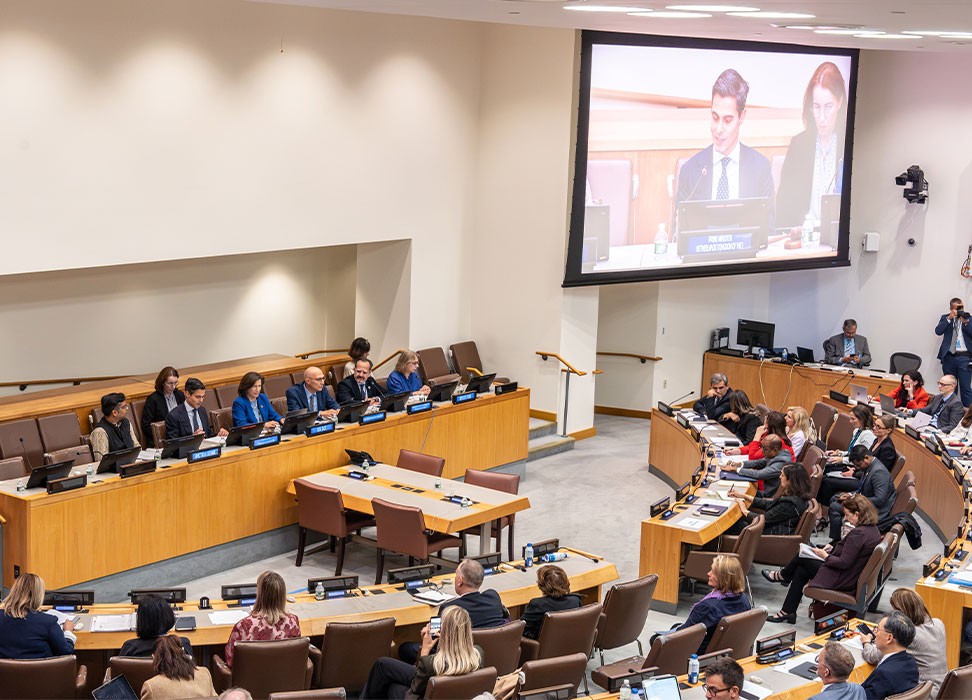
Human rights are our common pathway to solutions and meaningful change in people’s lives. That was a central message emerging from a high-level event during the 81st session of the UN General Assembly, as leaders, activists, youth, businesses and international organizations explored how to turn human rights commitments into collective action.
As the world confronts armed conflict, widening inequalities, climate change, democratic backsliding and rapid technological transformation, the Global Alliance for Human Rights is seeking to demonstrate how human rights can provide practical solutions to the challenges people face every day.
Co-organised by OHCHR, the Kingdom of the Netherlands and Mexico, and co-sponsored by Jordan, Liechtenstein and Estonia, the event marked an important milestone for the Global Alliance, an initiative launched by UN Human Rights Chief Volker Türk in June 2026 to accelerate a broader movement for dignity, equality and justice ahead of the 80th anniversary of the Universal Declaration of Human Rights in 2028.
Reflecting on the first 100 days of the Global Alliance, Türk said the initiative emerged from a growing recognition that the human rights community wants to do more than respond to attacks on rights and institutions.
While many people around the world feel frustrated, anxious and disconnected, he noted that surveys consistently show strong public support, particularly among young people, for values such as dignity, fairness, equality and inclusion.
"If you ask people around the world, especially young people, they care about fundamentally what human rights bring to the table," he said. "They may not always express it in these terms, but they do care about it."
The purpose of the Alliance, he explained, is to connect communities that often work separately — from governments and businesses to youth movements, cities, academics and civil society organizations — and build a broad coalition capable of bringing human rights back to the centre of policy and decision-making.
A central message throughout the discussion was that human rights provide a practical framework for addressing today’s challenges and improving people’s lives.
“Human rights are not a hobby for a small and privileged group. They affect us all and help create stable and prosperous societies, support sustainable development, and strengthen peace and security,” said Rob Jetten, Prime Minister of the Kingdom of the Netherlands.
He stressed that placing human rights at the centre of policymaking is both a moral imperative and a strategic necessity.
Enrique Javier Ochoa Martínez, Mexico’s Undersecretary for Multilateral Affairs and Human Rights, argued that the international community already possesses strong human rights standards and that the central challenge is implementation.
“We must move from a culture of commitment to a culture of implementation,” he said.
Human rights, he further noted, should be experienced in schools, homes, workplaces, communities and digital spaces. Political will, strong institutions and meaningful participation by affected communities are essential to turning commitments into concrete results.

UN Human Rights Chief Volker Türk joined Rob Jetten, Prime Minister of the Kingdom of the Netherlands; Melissa Fleming, UN Under-Secretary-General for Global Communications; and Enrique Javier Ochoa Martínez, Mexico’s Undersecretary for Multilateral Affairs and Human Rights, at a high-level event on the Global Alliance for Human Rights during the 81st session of the UN General Assembly in New York. © OHCHR
Denise Dora, Special Envoy for Human Rights and Just Transition for the COP30 Presidency, stressed that climate change is fundamentally a human rights issue.
While international debates often focus on emissions and finance, people experience climate change through lost livelihoods, displacement, health risks and growing inequality, she said.
“This is all human rights, not only at high level in tables of negotiation, but also it is translated into real and concrete life.”
The same applies to artificial intelligence and emerging technologies. Innovation, speakers stressed, should remain grounded in human rights, transparency, accountability and human agency, ensuring that technological advances strengthen rather than undermine people’s rights.
Human rights must help guide the digital future, including through education and AI literacy initiatives that empower young people to understand both the opportunities and risks associated with new technologies.
But translating human rights into action also requires changing how they are communicated — and who is included in shaping solutions.
This was also the central message of Amitabh Behar, Executive Director of Oxfam International, who suggested that the Global Alliance can play an important role in the move “from a legal-centric human rights approach to a people-centric approach” by bringing together a broad coalition of human rights advocates, climate activists, journalists, academics, lawyers and community organizations around a shared commitment.
He also warned that the growing concentration of wealth and power remains a major challenge for human rights.
"Human rights is essentially about challenging unjust power relations."
Personal stories and lived experiences can help bridge the gap between international debates and everyday realities, making human rights more accessible and relatable and showing how they connect to the lives of people everywhere.
Youth representative Emma van Nieuwenhuizen highlighted the work of young photographers and journalists documenting conflict, displacement and discrimination around the world. Through storytelling, she said, invisible realities become visible.
“In bearing witness, they give us the opportunity to walk the needed miles in their shoes and use that perspective to inspire change,” she said.
Naranzaya Batsaikhan, a youth representative and climate innovator from Mongolia, called for greater youth participation in decision-making processes and stressed that young people are already developing solutions to environmental and technological challenges.
“Our experience and energy can make these decisions stronger,” she said.
The Global Alliance is building towards the 80th anniversary of the Universal Declaration of Human Rights in 2028, with a vision for a significantly expanded global movement.
Türk spoke of more Human Rights Cities, stronger climate justice initiatives, greater youth engagement, increased participation by businesses, athletes, academics and community leaders, and broader protection for groups facing discrimination and exclusion.
“We should let our creativity and innovation thrive,” he said.
Across the interventions, a common message emerged: support for human rights remains broader than often assumed. While attacks on rights and democratic institutions are increasingly visible, people across the world continue to believe in dignity, equality, justice and inclusion.
As the Global Alliance enters its next phase, its message is clear: human rights must not only be defended, but actively advanced as practical solutions for a rapidly changing world.
Your donation protects the essentials we all rely on.