 Welcome to the United Nations

 OHCHR



Human rights don’t protect themselves.
Your donation protects the essentials we all rely on.
16 October 2026

“When our relatives were disappeared, we would have wanted the world to stop. For time to stop. But the world did not stop. It kept moving. And we had to keep moving with it,” said Alejandra Cartagena López, daughter of Leticia Galarza Campos, disappeared in 1978, and granddaughter of David Jiménez Fragoso, disappeared in 1975 in Mexico.
Cartagena López spoke at the Palais des Nations in Geneva, Switzerland, at an event marking 20 years since the UN General Assembly adopted the International Convention for the Protection of All Persons from Enforced Disappearance (CED). A feminist and a human rights defender, Cartagena López came to Geneva as the voice of 39 victims’ collectives she consulted before travelling.
Speaking alongside her were two of the people who drafted and negotiated the landmark treaty, the ten current members of the Committee on Enforced Disappearances that monitors it, and families from Sri Lanka, Sudan, Thailand, and Pakistan. Representatives of Member States and a wide audience filled the room.
“Victims First. Action Now” is the motto of CED20, the campaign marking the Convention’s 20th anniversary. At its centre is a Commemorative Wall where relatives of disappeared persons and those who stand with them have left more than 70 messages — testimony of how far a disappearance reaches into a family’s life. Opening the event, the Committee’s Chair, Juan Pablo Albán Alencastro, warned against mistaking the anniversary itself for an achievement.
“We must not confuse adopting a Convention with complying with it, and with making it transform people’s lives. The first happened twenty years ago. The rest is still in progress, and it’s our responsibility,” he said.
The event also marked the launch of “We Are Still Here: Putting Victims at the Centre of the Human Rights Movement,” a new initiative under the Global Alliance for Human Rights, which UN Human Rights Chief Volker Türk set in motion last June to connect people globally and across sectors and generations in support of human rights. The launch was supported by France, which also played a central role in negotiating the Convention two decades ago.
Where most work on enforced disappearance focuses on the search, the investigation and the courts, this initiative turns to what happens around them — the daily challenges that the relatives of the disappeared run into: the bank that freezes an account, the registry that cannot issue a child’s identity card, the passport that cannot be renewed, the school form with no proper box to check.
Between now and December 2028, the 80th anniversary of the Universal Declaration of Human Rights, the initiative will consult families across regions, document the legal, financial, social and educational consequences that follow a disappearance for years and across generations, and produce a practical guide — “developed with victims and for victims,” as Global Alliance coordinator Laura Dolci put it — together with recommendations for the public and private institutions whose procedures stand in the way.
“Healthcare systems, banks, insurers, social services and administrative authorities all too often rely on procedures that do not account for the legal and practical circumstances created by a person’s disappearance,” said Awa Dabo, Deputy High Commissioner for Human Rights.
“We had to work, care for our families, study, survive the pain and, at the same time, search,” Cartagena López said.
Angkhana Neelapaijit was a nurse when her husband, human rights lawyer Somchai Neelapaijit, was abducted by police in Bangkok in 2004. She is now a Thai senator and a former member of the UN Working Group on Enforced or Involuntary Disappearances.
“When the breadwinners disappear, women have to pay for everything, all the bills, house rent, children going to school,” she said.
“Many families have to move to other places, like a cheaper house,” Neelapaijit added. “But they still go back to the original house, because they believe that one day their father or husband will return, and they are afraid that if their loved one returns, he will not know where they are.”
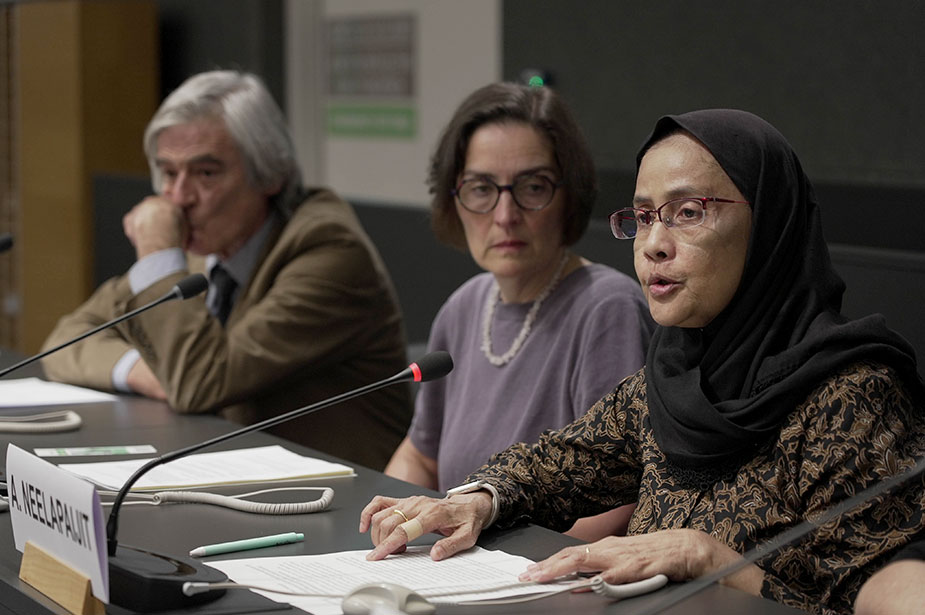
Angkhana Neelapaijit (right), whose husband, lawyer Somchai Neelapaijit, was disappeared in Thailand in 2004, speaks at the event marking 20 years of CED at the Palais des Nations, Geneva, 24 September 2026. Federico Andreu-Guzmán and Catherine Calothy are shown from left to right. © OHCHR/Jón Björgvinsson
Like in many countries, in Pakistan, the obstacles come with paperwork. Amina Masood Janjua was an artist and a mother of three when her husband, Masood Janjua, boarded a bus on 30 July 2005 and never arrived at his destination.
“When the child is of the age of 18 years, he or she gets the national identification card, and that is not made when the father is not there,” Amina said. “If they want to get a passport, they can’t. And the inheritance issue is that you have to declare that your father has died. So, nobody is ready to give a death certificate to somebody who has disappeared by the hands of the authorities.”
Talia Khan Khattak, a UN Human Rights staff member, had an exam the next morning when her father, Idris Khattak — a researcher who had spent years documenting disappearances in Pakistan — was himself disappeared in November 2019. He was held in an unknown location for more than two years.
“I was not an orphan, but no form had a box marked ‘disappeared.’ Profession? What could I write — ‘retired’? I have checked that box many times, and every time wished it were true,” Khan Khattak said.
“Legally, he was neither with us nor gone,” she added. “And so, neither were we.”
Mexico, with more than 130,000 disappeared persons, has tried to legislate that limbo.
“The declaration of absence keeps the rights of the disappeared person intact. That is, they are not dead, they are disappeared,” Cartagena López explained. “At the beginning, the only option was the presumption of death, and that meant, from the outset, accepting that they were dead. One of the basic principles is to search for them alive. And they are alive, literally, until we are shown otherwise.”
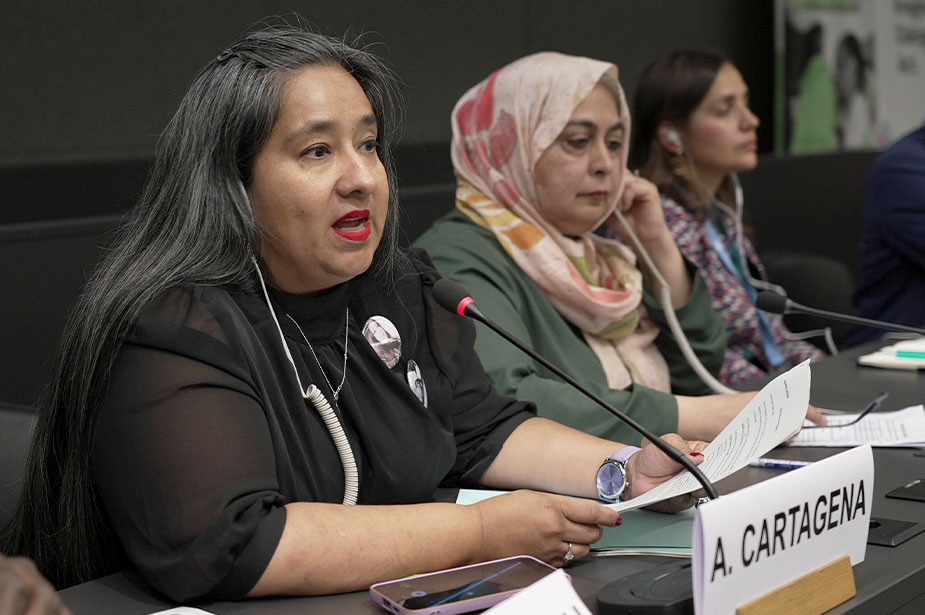
Alejandra Cartagena López, whose mother and grandfather were disappeared in Mexico in the 1970s, addresses the audience at the Palais des Nations, Geneva, 24 September 2026. Beside her Amina Masood Janjua of Pakistan. © OHCHR/Jón Björgvinsson
Dabo said that progress was real — stronger legal protection, national reforms, international cooperation — but set a single test for it.
“Our response must therefore be shaped and pursued with victims, survivors and families, and not merely on their behalf,” she said.
Four women, different relationships to the treaty. Thailand ratified it. Mexico ratified it and received a Committee visit in 2021. Pakistan has neither signed nor ratified.
“If you ask what’s the name of the victims of enforced disappearance in Thailand, everybody will say we don’t know, because they never documented the cases,” Neelapaijit said. “But when we submit the cases to the UN, at least our name is on the record. It’s really meaningful, even though nobody believes that the victims disappear, at least there is a record of victims.”
For Cartagena López, a record is no longer enough.
“We are tired of being listened to. Everybody listens now — but we never get to the other side,” she said. “What we want is for the Convention to be a tool that lets us demand, that lets us push, that gets us better investigations, that gets us searches, but above all, that lets us find them.”
Amina has not even that to lean on.
“Masood has been missing for 21 years. I don’t know if he will ever come home. But I know that if this Convention had bound my country in 2006, the search of thousands of Pakistani families would not have been fought so completely alone,” Amina said.
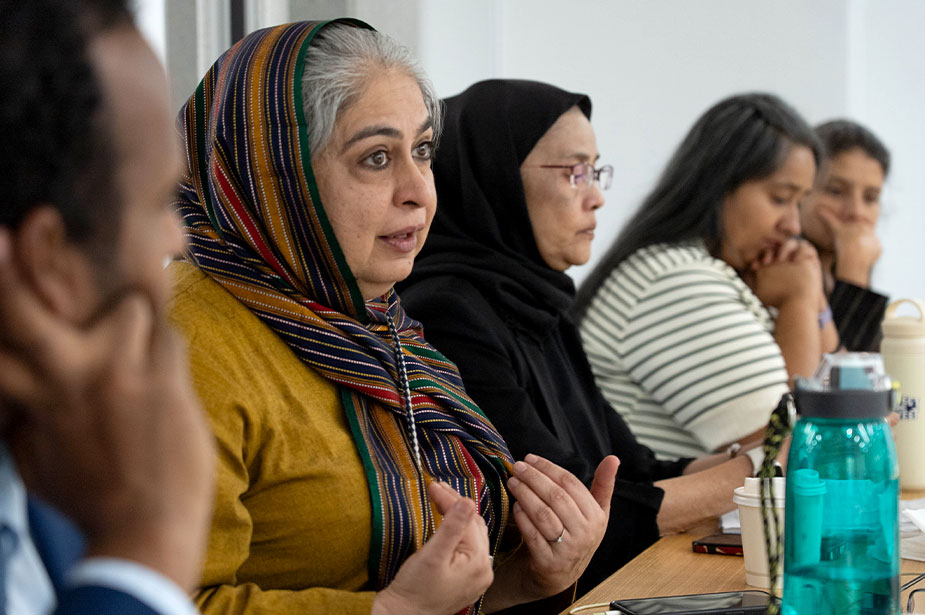
Amina Masood Janjua (Pakistan) speaks during the first working meeting of “We Are Still Here,” in Geneva 25 September 2026, alongside Angkhana Neelapaijit (Thailand) and Alejandra Cartagena López (Mexico). © OHCHR/Jón Björgvinsson
Cartagena López’s collective has a motto: aquí nadie se rinde — nobody gives up here.
“It has a lot to do with those politicians who say, ‘I’ve had enough’. Well, we don’t get tired,” she said. “We are stubborn for memory, stubborn about not forgetting, stubborn about searching for them. And of course, stubborn about finding them.”
Neelapaijit now works with women who have just lost a husband and don’t know where to begin.
“Instead of asking the victims, civil society or people should support them by raising our voices and asking on behalf of us, asking the government, asking State officers,” she said.
What held Amina wasn’t an institution.
“When I landed into something very imperfect and unjust, the artist within me actually died. Years later, with mighty effort, I started painting and sketching again,” she recalled. “It’s a big catharsis really. Similarly with poetry — now when I write, I cry. I cry a lot. And that was what was missing, because I was not crying.”
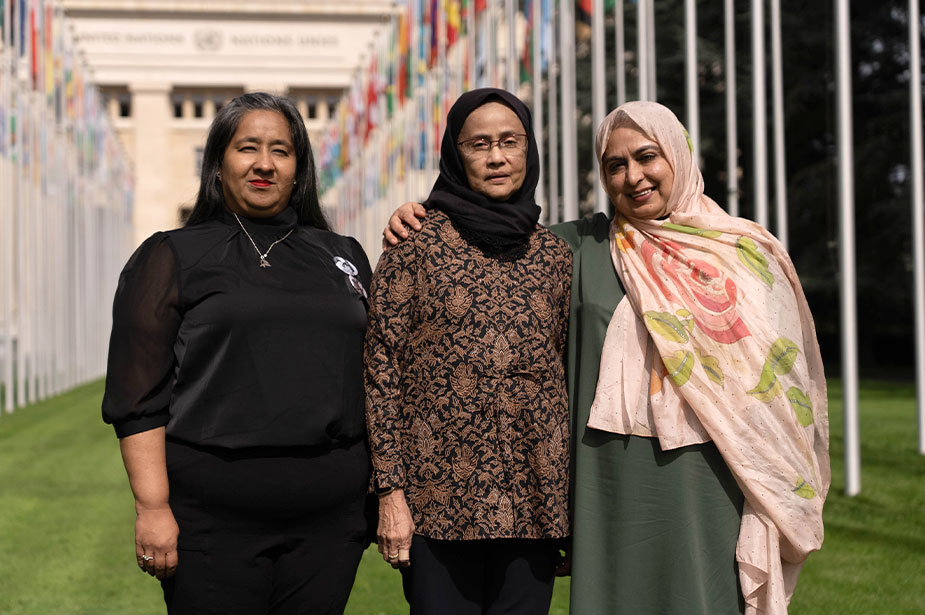
Alejandra Cartagena López (Mexico), Angkhana Neelapaijit (Thailand) and Amina Masood Janjua (Pakistan) in Palais des Nations in Geneva, where they spoke at the event marking 20 years of the Convention against enforced disappearances, 24 September 2026. © OHCHR/Jón Björgvinsson
A phone call by Khan Khattak closed the circle between the two Pakistani women.
“One night at three in the morning, I was convinced that speaking up about my father had made things worse for him,” she said. “I called Amina aunty. I cried on the phone. She comforted me and reminded me I was not alone. I genuinely believe she saved my life that night. No institution gave me that. Another family did.”
“We have to create a network,” Khan Khattak added. “Connect families, survivors, and those who inherit this reality with no instructions. A network you can go to when your heart is breaking at 3am.”
That network is what “We Are Still Here” hopes to grow. The name of the initiative is borrowed from Walter Salles’ film “I’m Still Here” and the story of Eunice Paiva, who waited 25 years for her husband’s death certificate following up his enforced disappearance under Brazil’s dictatorship and became a lawyer in the meantime.
The “we”, Dolci said, “is first the sum of the many ‘I’s” — the families — but can widen to take in States, businesses, universities, anyone willing to change how an institution treats a family that is still waiting. The first project meeting took place the day after the launch event.
“To all the victims and families who are still searching, still demanding truth and justice: we are still here, and we will remain at your side,” Albán said.
My father cannot speak here. So, I am. We are still here.
— Talia Khan Khattak, Associate Information Systems Officer at UN Human Rights

VIEW THIS PAGE IN:
Your donation protects the essentials we all rely on.