 Welcome to the United Nations

 OHCHR



Human rights don’t protect themselves.
Your donation protects the essentials we all rely on.
01 July 2025

For over 30 years, Elizabeth lived in limbo. With an unstable migration status, even basic rights felt far away. Through her story, UN Human Rights intends to raise awareness about why pathways for regular migration are important.
“Our comic, ‘A pathway to compassion,’ tells the story of Elizabeth and her struggle due to her insecure migration status and the power of solidarity,” said Geneviève Säuberli, human rights officer with the Migration and People on the Move Unit at UN Human Rights.
Illustrated by Magda Castría – Argentinian artist, feminist and activist – the comic, for Säuberli, is a reminder of how everyone can be part of demanding fairer systems and rules around migration.
“Migration is an intrinsic part of the human journey, yet restrictive policies persist, causing harm and suffering at every stage of the migration cycle,” said Säuberli.
For Castría, Elizabeth is a star.
“I think it’s one of the stories that has touched me the most,” Castría said. “The fact that so many years have passed, and she still can’t regularize her status is heartbreaking.”
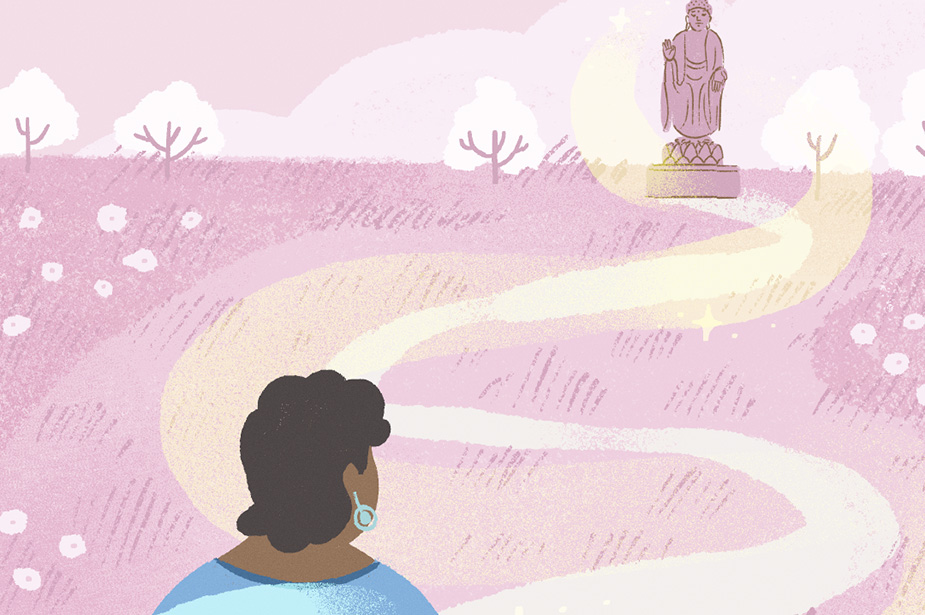
Elizabeth had lived in her new country for over 30 years but remained in an uncertain, irregular situation. Credit: ©OHCHR/Magda Castría
“In a world where migration is often politicized and people on the move scapegoated, leading to fear and division, it is crucial to highlight solutions that uphold human rights rather than undermine them,” said Säuberli.
Ever since she was a little girl, Castría loved to draw. Attending public school exposed her to different social realities, which sparked her early interest in social struggles and human rights. She went on to study graphic design, but it was in 2018 during the massive feminist movement in Argentina known as la marea verde (the green tide), demanding legal, safe and free abortion, that she realized illustration and activism were deeply connected for her. Through her art, she could express what she was feeling, inspire change, and build community among women.
“Illustration as a tool has a huge symbolic power. It allows us to represent things that cannot be seen, emotions, absences,” Castría said.

Magda Castría, a feminist illustrator and graphic designer from Argentina. ©Magda Castría
Castría aims at inspiring empathy, spark conversations, and provoke questions.
“To also appeal to tenderness, to care, you know? To talk about topics that are sometimes difficult, but in a way that allows us to connect,” she said.
Elizabeth’s journey inspired Castría.
“To be in another country, with another language, and still remain strong, offering others all that love and empathy, is truly inspiring,” Castría said.
According to Säuberli, Castría’s evocative illustrations reveal both the simplicity and the powerful impact of stories like Elizabeth’s.
“Using a hope-and-values-based approach to storytelling, our regional and country presences along with civil society partners and activists from the Pacific to South America, have facilitated conversations about migration and how we can achieve change together,” Säuberli said.
UN Human Rights offers practical solutions for how everyone can be safe, thrive, and belong. With the objective of changing narratives, attitudes and behaviour on migration, UN Human Rights has a Toolbox on Migration Narrative Change, of which comics are part of.
UN Human Rights’ broad protection mandate entails the promotion and protection of the human rights of all people.
UN Human Rights analyses how laws, policies and practices affect people on the move, including by directly speaking to them and those who defend their rights.”
Geneviève Säuberli, human rights officer, Migration and People on the Move Unit, UN Human Rights
The Office assists governments and other stakeholders on how human rights can act as powerful tools to make systems better for everyone and make sure no one gets left behind.
“I think it’s great that UN Human Rights turned to this tool, to have characters that people might connect with more easily or empathize with,” Castría said. “I think it’s incredibly powerful and, of course, essential for promoting more positive narratives, especially in this context.”
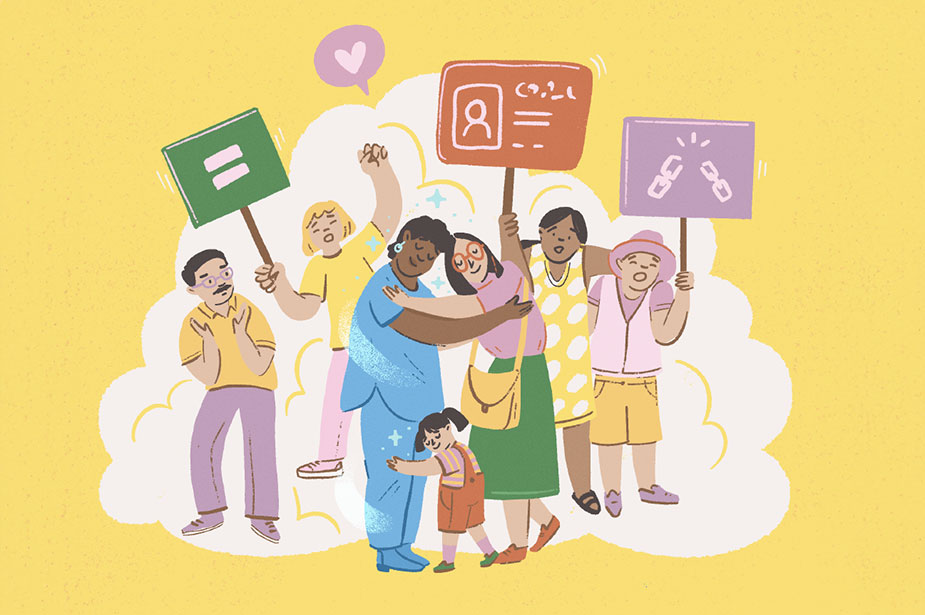
In a new migration story from UN Human Rights and illustrator Magda Castría, Elizabeth's community believed it was unjust and inhumane for her to be treated unfairly and to live in uncertainty. They wanted to help her and others like her and demanded a fair migration system where everyone had a chance to live safely and securely. © OHCHR/Magda Castría
Säuberli said that several countries and regions have implemented promising practices to support migrants through regularization based on humanitarian and protection grounds.
In Mexico, victims or witnesses of serious crimes can apply for migration status regularization and Australia is allowing victims of partner violence holding a Partner visa to seek permanent residency even if the relationship ended.
In addition, Italy protects unaccompanied children from deportation and grants them residence permits until age 18 and in East Africa, the Intergovernmental Authority Development (IGAD) Free Movement Protocol ensures access for people displaced by disasters or climate change.
Also, Thailand has repeatedly regularized undocumented migrants from neighbouring countries, allowing them to live and work legally for up to two years without requiring return to their home countries.
Still, many challenges remain.
When regular pathways are not available, accessible or secure, Säuberli said, people on the move find themselves in situations of vulnerability, exposed to the risks of marginalization, exploitation and uncertainty.
“Migrants are often barred from working, excluded from healthcare, and denied basic stability,” Säuberli said. “Not because they’ve done anything wrong, but because many systems offer no fair or accessible way to regularize their status.”
During his most recent Global Update speech at the Human Rights Council, UN Human Rights Chief, Volker Türk urged EU countries to put human rights at the centre of new regulations on returns and migration governance more generally, including by expanding safe and regular pathways.
UN Human Rights has consistently called for safe and fair migration pathways and systems, and engages in legal policy work addressing human rights challenges, proposing rights-based solutions and highlighting promising practices.
“We hope that the illustrations will inspire our readers to use them, join us and stand up for human rights of people on the move,” Säuberli said.

In the new comic, A pathway to compassion, by standing together and taking action for change, the community found new ways to thrive and proved that fairness, equal rights and dignity are a sure pathway to a brighter future for all. © OHCHR/Magda Castría
Your donation protects the essentials we all rely on.