 Welcome to the United Nations

 OHCHR


Human rights don’t protect themselves.
Your donation protects the essentials we all rely on.
08 October 2026

In 2021, Bukayo Saka, Marcus Rashford and Jadon Sancho helped take England to the final of the European Championship. After the defeat, the three players of African descent faced a torrent of racist abuse.
Since then, the incidents have kept coming. Five years later, French footballer Kylian Mbappé faced racist and dehumanising comments online.
UN Human Rights condemned the comments as “despicable and, regrettably, not isolated”, pointing to reports of racist incidents during the FIFA World Cup 2026.
Different competitions, different targets. But both incidents show that even the most accomplished athletes are not beyond the reach of racism and discrimination.
Two UN reports look beyond these high-profile incidents to examine the many ways racism shapes the lives of people who play sport, and those who hope to.
In his report, UN Human Rights Chief Volker Türk called for confronting the systemic barriers that allow racism to persist within the world of sport. He emphasised that States, sports bodies, civil society, the media, and the private sector must work collectively to dismantle barriers that continue to affect racialised groups’ access to and participation in sport.
In her report, Ashwini K.P., UN Special Rapporteur on contemporary forms of racism, racial discrimination, xenophobia and related intolerance, examined and challenged the structures that determine who gets to participate, progress and lead.
Rather than being recognized as a systemic and structural issue, racism in sport is too often treated as a series of isolated incidents.
UN Human Rights Chief Volker Türk
Before a child joins a sports team, someone has to pay for the equipment, the lessons and the journeys to training.
According to Ashwini K.P., for families from marginalised racial and ethnic groups, those costs can put entire sports — swimming, cycling or tennis — out of reach. Their schools and communities may also lack the facilities they need. These missed opportunities can cut short aspirations to professional sport at an early age.
Children excluded from sport lose more than the chance to compete. They lose opportunities to make friends, build confidence and find a place in their community.
Poverty and income inequality and the way they impact access to sport are not race neutral.
Ashwini K.P., UN Special Rapporteur on contemporary forms of racism, racial discrimination, xenophobia and related intolerance
Ashwini K.P. linked these challenges to histories of colonial exploitation and unequal investment, including disparities between countries in their capacity to support sport.
Cost is not the only obstacle, and children are not the only ones shut out.
At a regional consultation for Latin America organised by UN Human Rights, participants described barriers to accessing sports facilities for Indigenous communities, including geographical isolation, chronic underfunding and sports programmes that overlooked their cultures. The same consultation found that residency and legal status requirements effectively denied migrants and asylum-seekers access to public sports programmes and facilities.
Years of training, and even international success, do not necessarily secure an athlete’s place in sport when racism and discrimination shape the rules.
Caster Semenya, a Black South African runner, challenged rules introduced by World Athletics in 2018 requiring women athletes with certain variations in their sex characteristics to artificially lower their natural testosterone levels to compete in women’s events. In 2025, the European Court of Human Rights ruled that the Swiss Federal Tribunal had not fully taken her human rights into account when reviewing the decision of the Court of Arbitration for Sport to uphold the World Athletics rules.
Her case is not an isolated one, and the warnings are not new. As far back as 2020, the then High Commissioner for Human Rights warned that such regulations disproportionately affected women athletes from sub-Saharan Africa and South Asia. The report called on States to make sure anti-discrimination laws cover gender, race, and sex characteristics and bind sports and governing bodies, and urged States and sports bodies alike to challenge gender-stereotyped and racist portrayals of women and girl athletes in the media.
The following year, three UN mandates told the European Court of Human Rights that the rules had fallen the hardest on Black women athletes and women athletes of Asian descent, mostly from the Global South, and appeared to rest on the assumption that white femininity is the standard in elite sport — casting women who do not “fit” that image as masculine.
Alexandra Xanthaki, UN Special Rapporteur in the field of cultural rights, questioned the scientific evidence underpinning the rules on eligibility for the female category in a 2024 report, and warned of their disproportionate impact on women from sub-Saharan Africa and South Asia. Ashwini K.P. observed that women from marginalised racial and ethnic groups are too often targeted because they do not conform to Western cultural stereotypes of femininity.
Blake Leeper, a runner of African descent with amputations below both knees, challenged the maximum height permitted when using running prostheses. In the words of his team, the formula was based solely on measurements of Hispanic and Caucasian athletes.
Dress rules can exclude, too. A 2025 regional consultation for Europe organised by UN Human Rights revealed that, in some contexts, Muslim women and girls were unable to practise grass-roots, amateur and professional sport due to bans on religious attire or due to an enforced attire, arising from decisions by some Governments and sport federations.
In some countries, national federations, including those governing football and basketball, prohibit religious head coverings. One submission to Ashwini K.P. described playing sport without a head covering as women being forced to give up a part of who they are.
Speaking at the Human Rights Council, Awa Dabo, UN Deputy High Commissioner for Human Rights, stressed that human rights standards require respect for both the freedom to choose to wear religiously significant attire and the freedom to choose not to wear it. She also warned that the reintroduction of mandatory genetic sex tests by some governing bodies raises serious concerns about bodily integrity, informed consent and privacy.
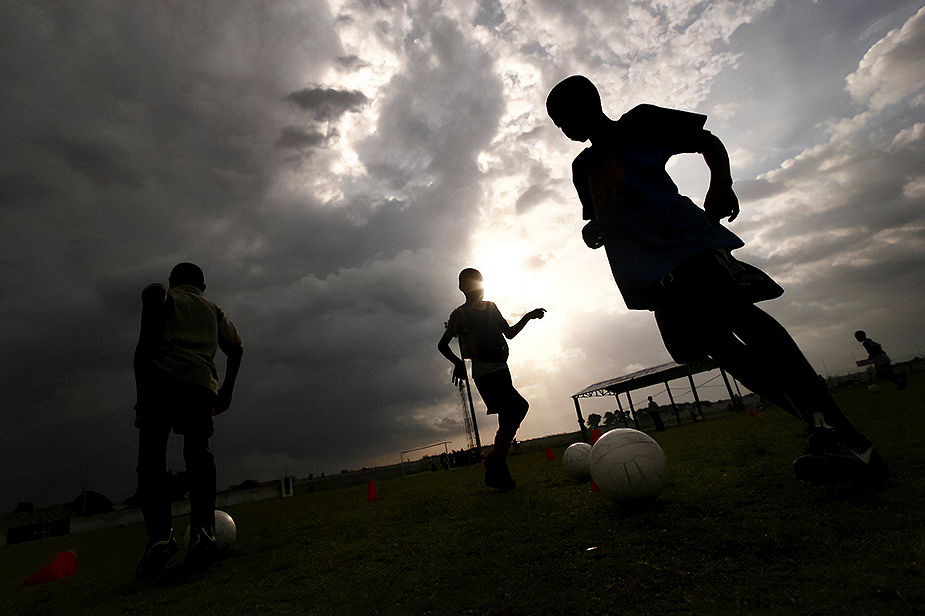
Young Haitians practice soccer at L'Athlétique d'Haiti, a school sports and tutoring program that benefits children from Cité Soleil and Bel Air slums of Port-au-Prince, Haiti. © UN Photo/Logan Abassi
Making it onto the field does not mean the barriers fall away.
Ashwini K.P. described “racial stacking” as steering racialised athletes towards positions associated with physical ability or quick reactions, rather than leadership.
Behind that practice lies a familiar stereotype: that racialised athletes bring strength and speed to the game, but not strategy or judgement. UN Human Rights consultations heard the same false assumption in another form. Black athletes were praised for their physical abilities while their intellectual contributions to the game were often overlooked.
Ashwini K.P. also pointed to the predominance of white men in senior positions in European football, alongside research linking this underrepresentation to shortcomings in institutional responses to racism.
Athletes can be highly visible in competition yet have little say in the institutions that decide their future.
For Saka, Rashford and Sancho, the attacks spread through social media platforms that could — and should — have acted much faster. Research cited by Ashwini K.P. found at least 80 racist insults directed at Saka posted on his social networks. Some remained online for more than a full day despite being reported.
During the 2024 Olympic Games, monitoring by the International Olympic Committee found that 15 per cent of the abusive content detected in connection with the Games was racist, according to Türk’s report.
In May 2023, Vinícius Júnior, the Brazilian forward who plays for Real Madrid, was once again met with racist insults during a match in Spain's top football league. By then, the abuse had become a recurring feature of his time in La Liga. Speaking in Geneva days later, Türk called it "a clear reminder of the prevalence of racism in sport" and urged the organisers of sporting events to put strategies in place to prevent and counter it. Vinícius later joined UN Human Rights in campaigns against racial injustice and racism in sport.
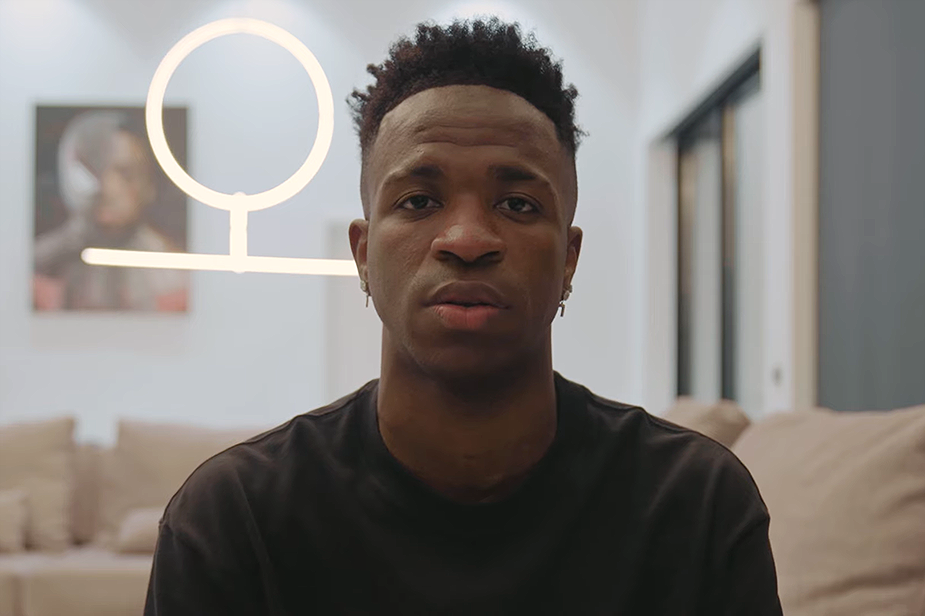
Vinícius Júnior, a Brazilian football player of African descent, records a video message calling for effective measures to combat racism in sport. © OHCHR
According to consultations carried out by UN Human Rights, abuse follows players off the pitch, affecting their mental health, their relationships and livelihoods. Speaking up carries its own risks. Some fear being shut out of professional opportunities or facing reprisals. Others run up against complaints procedures that do not exist or are costly, fragmented or difficult to navigate.
Addressing these obstacles requires systemic change based on evidence. States and sports bodies should collect and analyse data broken down by race, ethnicity, gender, age and other relevant factors, in line with human rights standards. The data should capture representation gaps, track participation, incidents, complaints and follow-up — with effective community participation. Social media platforms must tackle racist abuse and provide effective avenues for review and redress.
Under the UN Guiding Principles on Business and Human Rights, organisers of major sporting events have a particular responsibility to assess discrimination risks before choosing host locations and to prevent discriminatory practices by governments and any relevant stakeholders to the game.
In his report, Türk recommended directing a share of the revenue from profitable events to promote the inclusion and participation of groups that are excluded from sport, in particular due to racial discrimination.
Both reports called on sporting bodies to set up independent complaints mechanisms and provide effective remedies, invest in grassroots access, diversify their leadership, and consult athletes before writing eligibility rules. Türk also stressed that athletes who report racism must be protected from reprisals.
For athletes, progress towards ending racism will be measured in practical terms: being able to play the sport of their choice, being treated fairly, and knowing that speaking out against abuses will bring protection, not greater risk.
Your donation protects the essentials we all rely on.